 |
There must be a couple hundred words to describe a Keynote.
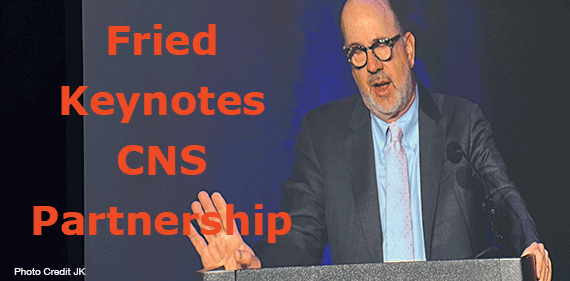
But two come to mind that work well together as we share the opening speech that Brandon Fried just delivered to the 35th Annual Cargo Network Services (CNS) Partnership Conference going on today May 19 through May 20 in Downtown San Francisco at the Union Square Hilton Hotel.
Meat and potatoes is what this air cargo booster delivered in his to-the-point keynote address this morning.
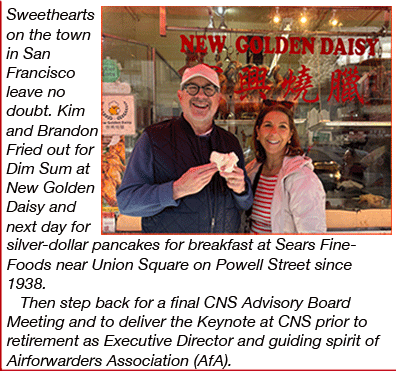 Everybody knows Brandon as the Executive Director, front man and guiding spirit of Airforwarders Association (AfA). Everybody knows Brandon as the Executive Director, front man and guiding spirit of Airforwarders Association (AfA).
But the work Mr. Fried has done for the past decades, bolstering and building organized air cargo at the local level across the USA, and all around the world is an effort unmatched by anybody else in the history of air cargo.
You have to look way back, a half century ago to the last time someone gave of themselves to the universal proposition of air cargo organizing itself, with the aim of making the industry work better. During the 1970s John Emery, Jr. teamed up with John Mahoney, the great genius from Seaboard World Airlines, as advisor.
Both operated from Emery Air Freight HQ in Wilton, Connecticut and the pair put it all in, working diligently for International Air Cargo Association (IACA) during a time when John Jr., was CEO of Emery Air Freight and served as president of IACA.
Emery Air Freight, founded by John Emery Sr., was a company that practically invented air freight forwarding in USA.
After Emery, IACA just drifted away, but later with people like Bill Spohrer, Bob Arendal, Chris Foyle, Isaac Nijankin, Buz Whalen, Bill Boesch and some others, IACA was reborn as TIACA.
This somewhat cautionary tale here comes with the hope that Brandon’s retirement will maybe keep him somewhere at arms-length that he might pop in for an occasional cameo at industry gatherings.
Not the vortex anymore, but the gentle shepherd for a flock of people and clubs in air cargo that have depended on Brandon for years.
Here today is Brandon’s take on things underlining “partnership”, included in a Keynote at CNS Partnership Conference this morning in San Francisco.
 Good morning. Good morning.
There's something both fitting and a little bittersweet about being here in San Francisco as I prepare to step down after leading the Airforwarders Association. So let me use this time well — not for ceremony, but for substance.
Freight forwarding doesn't headline news cycles. It doesn't have a cultural moment. What it has is practical, daily importance to how the world functions. When a ventilator reaches the ICU, when an auto part arrives before the assembly line stops, when an e-commerce package appears on a doorstep 24 hours after ordered, a freight forwarder was somewhere in that chain, solving a problem most people will never know existed.
 Think about what this industry did during COVID-19. In March 2020, passenger belly capacity — roughly half of global air freight capacity — collapsed almost overnight. Within weeks, freight forwarders rebuilt the architecture of how air cargo moved. Charter networks scaled. Freighter utilization hit records. Cargo-only operations ran on widebody passenger aircraft for the first time in modern commercial aviation. Forwarders navigated shifting government restrictions, priority designations, and supply chains under enormous pressure — and they got the PPE to the hospitals. They got the vaccines distributed at historic speed. That's not a talking point. That actually happened. Think about what this industry did during COVID-19. In March 2020, passenger belly capacity — roughly half of global air freight capacity — collapsed almost overnight. Within weeks, freight forwarders rebuilt the architecture of how air cargo moved. Charter networks scaled. Freighter utilization hit records. Cargo-only operations ran on widebody passenger aircraft for the first time in modern commercial aviation. Forwarders navigated shifting government restrictions, priority designations, and supply chains under enormous pressure — and they got the PPE to the hospitals. They got the vaccines distributed at historic speed. That's not a talking point. That actually happened.
We're seeing the same principle tested again. Conflict in the Middle East is disrupting shipping lanes, airspace, fuel costs, and capacity planning. Once again, freight forwarders are doing the practical work of keeping goods moving — finding capacity, rerouting shipments, advising customers, protecting the flow of pharmaceuticals, components, and perishables. In moments like these, logistics is not just a commercial service.
It is continuity, security, and peace of mind.
The same is true when trade policy changes faster than businesses can plan. Tariffs create uncertainty across the supply chain. Forwarders can't remove that uncertainty, but we help businesses manage it. When TSA, CBP, and FAA functions are strained by budget and staffing pressures, cargo slows, clearances become unpredictable, and businesses across the country feel it. Air cargo is economic infrastructure. It is national security infrastructure. Policymakers need to treat it that way.
On digitalization: progress is real but unfinished. The shift to electronic air waybills took longer than it should have, and full adoption of IATA's ONE Record standard still has a way to go. Getting there matters — for efficiency and for the supply chain visibility that regulators and customers increasingly expect. Forwarders who are ahead of that curve will be better positioned for everything that follows.
Now I want to spend the bulk of my remaining time on a contribution this industry has made that rarely gets the credit it deserves: aviation security.
 |
Not long after September 11th, I was on Capitol Hill explaining the differences between freight forwarders and integrated carriers, walking through the Known Shipper program, building the case that distinct segments had distinct risk profiles.
A member of Congress let me go for a minute or two, then held up his hand.
"Stop," he said. "I don't care what the differences are between all of you. To me, you are all dangerous."
That was clarifying. Whatever distinctions mattered inside the industry were invisible to the people writing the laws. If the cargo community didn't engage constructively, we risked being regulated into something unworkable — or grounded entirely.
The 9/11 Commission flagged cargo in the belly of passenger aircraft as a vulnerability. Congress responded with a mandate: all cargo on passenger-carrying aircraft must be screened before departure. The volume was too high for airlines to handle alone. The answer was the Certified Cargo Screening Program — which put freight forwarders at the center of the aviation security apparatus as credentialed, trained, legally accountable partners. AFA members invested in the equipment, staff, compliance programs, and oversight infrastructure. They did that work. They still do it.
Then October 2010 reminded us why it matters. Two packages from Yemen — printer cartridges packed with PETN explosive — were intercepted after a tip from Saudi intelligence. One was aboard a UPS cargo aircraft. The other had already transited a passenger flight. Those were bombs designed to destroy aircraft. That plot accelerated the development of Air Cargo Advance Screening. Under ACAS, freight forwarders submit electronic manifest data to CBP before cargo departs for the United States, so high-risk shipments can be identified before they board. AFA members participated in the pilot, helped shape its operational requirements, and advocated for permanent authorization. We got it.
Freight forwarders have kept cargo flying on passenger aircraft, and they have done it safely. That record deserves acknowledgment. We have shown that public-private partnerships can work — but only when there is strong federal oversight setting the standards and enforcing compliance. Any move to weaken that oversight, as recent budget proposals have suggested, puts that security at risk. Applying this model to passenger screening without strict TSA oversight would significantly increase risk.
The challenges ahead are real. Cybersecurity vulnerabilities in cargo management systems are growing. Cargo theft — including truck fraud, where bad actors impersonate legitimate carriers to divert loads — has moved from occasional incident to operational reality. These aren't just insurance problems. They undermine the chain of custody the entire security framework depends on, and they demand better verification systems, stronger industry coordination, and regulators who treat them with the seriousness they warrant.
And the truck gate problem at our major gateway airports — JFK, O'Hare, LAX, Miami — isn't going away. Insufficient road capacity, inadequate staging facilities, and slow automation have created congestion that holds drivers for hours. Those waiting times are real costs that fall directly on the freight forwarder. Air freight's value proposition is speed. When a truck idles for three hours before it can move a shipment, that promise is broken. Airports, airlines, and government agencies need to treat infrastructure investment as the competitive issue it is, because Frankfurt, Dubai, and Singapore already have.
None of that changes what I see ahead. Freight forwarding is a growth business. Pharmaceutical and life sciences logistics, just-in-time manufacturing, and the expansion of global trade into emerging markets are structural drivers, not cyclical ones — and they all run in our direction.
To everyone in this room: you are already doing work that matters. The job is to keep showing up — in Washington, in Brussels, in conversations like this one — and make sure the people writing the rules actually understand what this industry does.
It has been my honor to serve as Executive Director of the Airforwarders Association. I leave knowing the organization is in good hands, its members are engaged, and the mission is as important as it ever was.
Now get back to work. The freight doesn't move itself.  |















 100%
Green
100%
Green