 |
Picture New York the way it used to feel. Before every curb became a loading dock. Before double-parked trucks turned whole avenues into a slow-motion argument. It’s funny, because the city has always had a highway system that never needed paving—water. All around us.
And yet we mostly treat the water like a backdrop. Like it’s there for photos and ferry rides, not for work. Meanwhile the streets carry the burden of everything: food, packages, building supplies, airport cargo.
So the big question is almost embarrassingly simple: why are the roads jammed while the waterways sit there underused?
That’s the idea behind New York City’s so-called Blue Highways. Not a single project, more like a mindset: move some of what’s choking our streets onto boats and barges, then finish the “last mile” with smaller, cleaner delivery options.
And it’s not just theory.
There’s a real, every day example that almost feels like a throwback in the best way.
The Bronx Fulton Fish Market Cooperative is sending fish shipments by low-emission boat down to the South Street Seaport in Manhattan.
Fish, by boat, in New York. It sounds like we accidentally stepped into a different century.
But it’s also modern logistics.
Each trip, from what we’re told, takes about two trucks off the road.
Two trucks isn’t going to rescue traffic overnight. But that’s not the point.
The point is proof.
Once you can point to a working route, the conversation changes from
“Could this work?” to “Where else can we do it?”
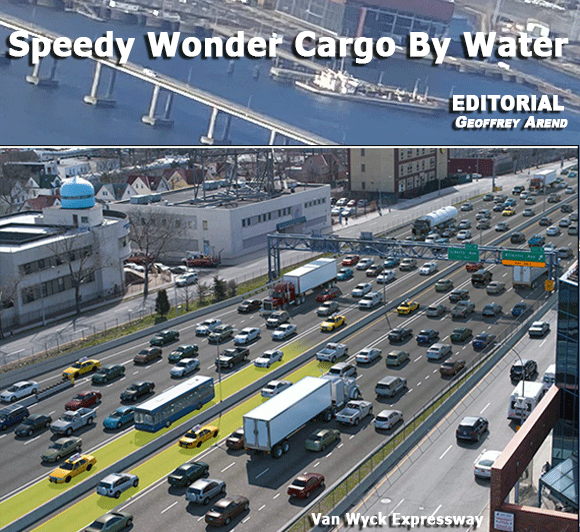
And if you’re looking for a place where the pain is so constant, people would try almost anything, one corridor jumps right out: the Van Wyck Expressway, the main thread tying so much of Queens to JFK.
If you’ve ever headed to the airport thinking you left early, and then watched your buffer evaporate, you know the Van Wyck isn’t just traffic. It’s a ritual of frustration.
What makes it even more maddening is the geography around JFK. There’s water nearby. Navigable water.
So here’s the tension: week after week, thousands of trucks grind through the same chokepoints while the water sits there as an untapped lane.
Shift even a slice of that movement onto boats and barges, and you might not only reduce congestion, you might make deliveries more predictable and, potentially, cleaner.
The Blue Highways concept breaks down into a few kinds of cargo that fit the water differently.
You’ve got micro-freight, smaller loads like parcels and food that can plug into a last-mile network, maybe even e-cargo bikes.
Then there’s containerized freight, full-size containers moved by barge. And then bulk freight: building materials, waste, heavy stuff that really doesn’t belong rumbling down narrow city streets if there’s another option.
And the loading methods matter too. Some systems are basically drive-on, drive-off. Others are crane-on, crane-off. Different tools, same goal: use water for the long stretch, and save the streets for the short, final steps.
We’ve already seen another pilot that makes this feel less like a slogan and more like a playbook. Late in 2025, there was a test route from Brooklyn’s Red Hook Marine Terminal to Pier 79 in Midtown. Consumer goods moved by boat, then transferred to pedal-assist electric bikes for delivery.
That handoff is the magic.
The heavy movement happens off the streets, and the last-mile part gets quieter, smaller, and frankly less chaotic.
You can almost feel the city exhale.
So why aren’t we doing more of it? Especially where the stakes are so high, like the supply chain around JFK Air Cargo?
 |
Because big systems are sticky. Airports are complicated. Agencies overlap.
And there’s a governance wrinkle that surprises a lot of people: the Port Authority operates JFK and LaGuardia, but it’s not as simple as outright ownership.
There are long-term lease structures, layered responsibilities, and that can make accountability fuzzy even when the problem is obvious.
Meanwhile, the experience stays brutally clear for everyone sitting on the Van Wyck.
Lost time, unpredictability, pollution, stress.
And that’s why the fish boat matters beyond fish.
It’s a signal that the city can still move the way it once did.
Someone at the South Street Seaport Museum, Johnathan Boulware, summed it up with that familiar line: “Everything old is new again”.
And that’s our feeling here.
If fish can go by boat to the Seaport, and consumer goods can sail from Red Hook to Midtown, then the waterways aren’t the question anymore.
The question is will.
Will we take this thinking to the places that need it most?
So let me throw out a scenario. What if we ran a measured, time-limited cargo test between Newark and JFK by water?
Consolidated shipments moving both ways, on a schedule, for a couple of months.
A clean experiment: fewer variables, fewer roadblocks, literally fewer trucks.
It wouldn’t be cheap.
There’d be funding questions, agency questions, operations questions.
But that’s what pilot programs are for,
You don’t need perfection. You need data. You need to see what happens when you give cargo a new lane.
And this isn’t even a totally new dream.
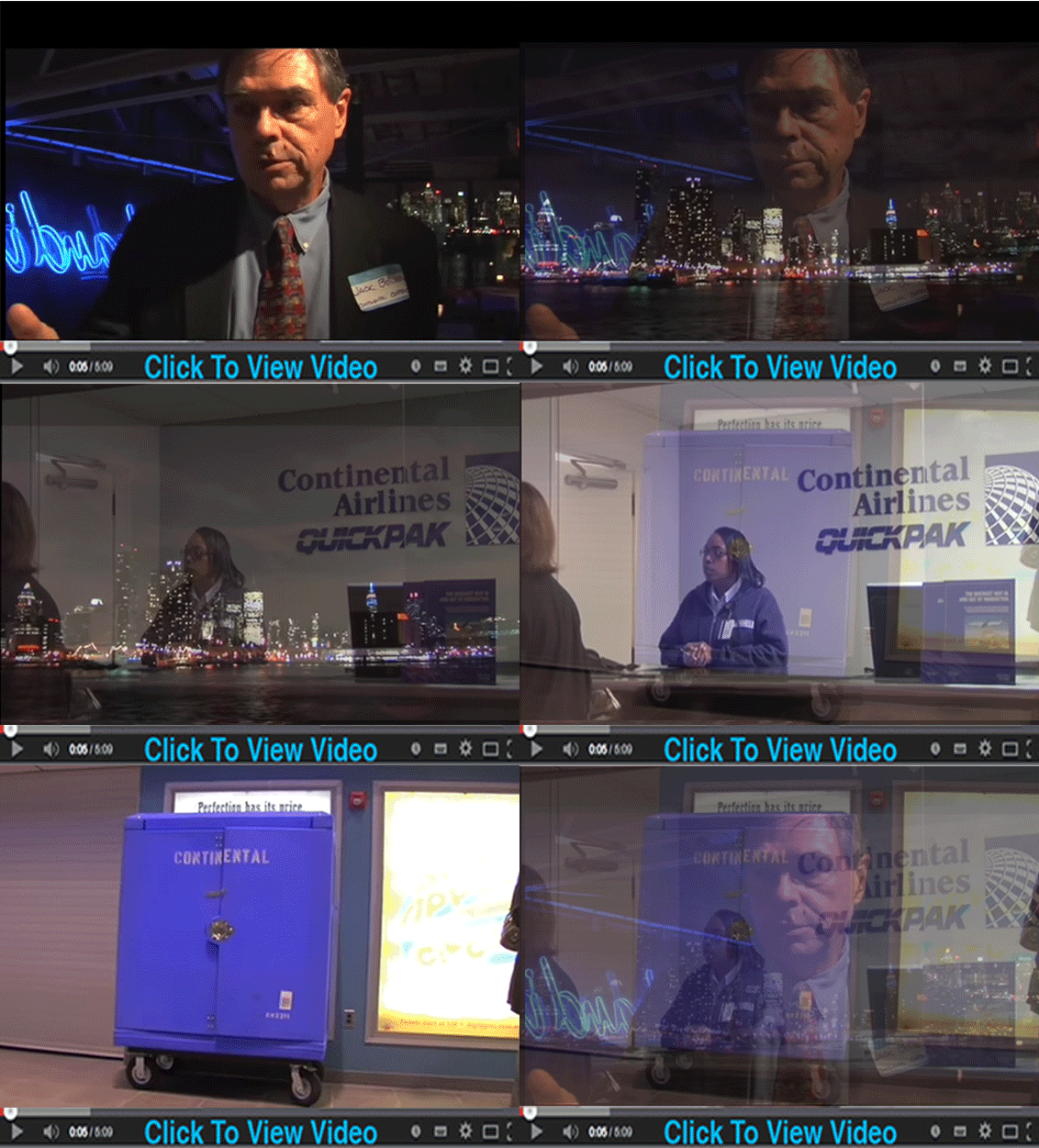
Back in 2007, Continental Airlines Cargo with Jack Boisen (now well retired) tried something that, for the industry, was a big swing at the time: moving express shipments by water from Newark into Midtown Manhattan. It was called QuickPak, and it was a real attempt to rethink the usual routes.
There’s even a video we did, a time capsule of that moment.
Whatever you think of the outcome, it’s worth recognizing the mindset: someone in air cargo looked at the map and said,
“Why are we ignoring the water?”
So now we’re here again. Boats are running. A pilot program is happening.
The logic is sitting right in front of us, as obvious as the shoreline, and biting all of us right on the fanny
And that’s where we’ll leave it, not with a neat conclusion, but with a challenge.
If you’re in those logistics rooms, if you’re staring at the Van Wyck and wondering how this became normal, maybe the next move is the old move.
Take the water seriously. Try something bold, but measurable. And if you’ve got ideas, genuinely, share them. Because this city can’t keep paying for gridlock like it’s a tax we just accept.
|










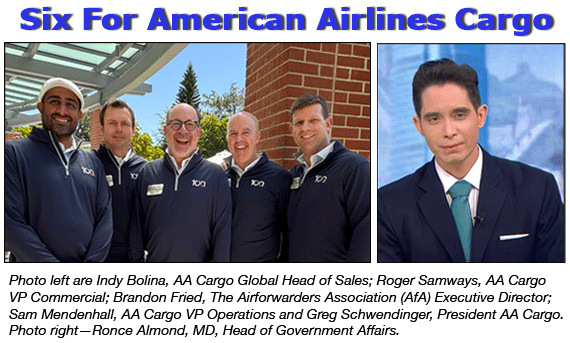
 “The session drew a strong turnout from leading forwarders and featured updates from American’s Cargo leadership pictured above that also included, Richard Brueland, Customer Care Manager (left).
 “Drawing upon his prior role as Senior Counsel to the Senate Commerce, Science and Transportation Committee, Ronce provided a clear and timely overview of the current legislative and regulatory landscape in Washington.
 100%
Green
100%
Green