 |
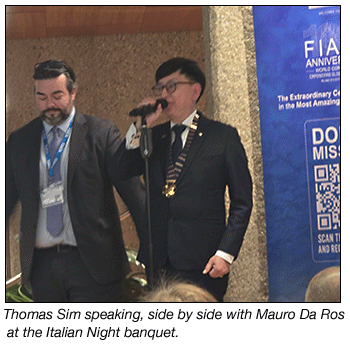
At the end, when all was said and done, we were all invited to the Italian Night, where Mauro Da Ros, President of the Fedespedi’s Organizing Committee, gave a short and effective speech highlighting – were it necessary – the opportunities offered by the congress in Milan. Fedespedi was congratulated for the quality of the reception, which was remarkably good. This was the auspicious end for this year’s HQ session and I mean auspicious because everyone is expected to gather again in Milan at the beginning of October to celebrate the centennial from FIATA’s foundation, which took place on May 31st 1926, precisely one hundred years ago.
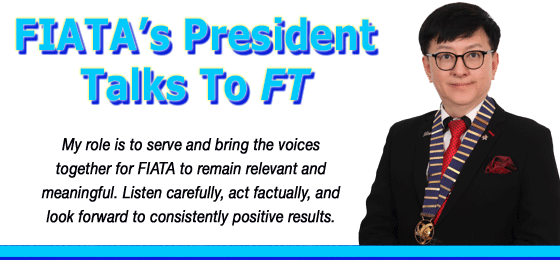
 The HQ sessions had reached its finishing tones with the fire chat between Thomas Sim, as President and Stéphane Graber, as DG of FIATA. During the conversation, which was centered on discovering the new President’s personality, a human, caring aspect of Thomas’s personality came to the fore and there was a good understanding of where this man, who became FIATA President in 2025, was coming from, indeed a perspective quite far from the podium and the limelight. Thomas described himself as a family person, a person who loves reading. Logistics was not something he chose from the very beginning, Thomas’s initial career was that of a fighter jet pilot (for eight years), a really different career from what he had thought of whilst at school. “Flying a fighter jet is about discipline and precision, you cannot make mistakes, much depends on these qualities.” There is also much study about avionics and human performance, etc. all elements that were very important in his formation. An almost bewildered Stéphane Graber underlined that Thomas was his fourth president, and observed his predecessors had underlined how this task was a heavy one. Thomas, who surely did not take this question as an opportunity to magnify his duties, explained his understanding on serving as President at the base of which stands the trust that members have placed in the President. “My role is to serve and bring the voices together for FIATA to remain relevant and meaningful. Listen carefully, act factually, and look forward to consistently positive results, were in good summary the elements of Thomas’s recipe to a successful tenure in FIATA, an association with a worldwide coverage in excess of 40,000 logistics enterprises and national associations and federations. The HQ sessions had reached its finishing tones with the fire chat between Thomas Sim, as President and Stéphane Graber, as DG of FIATA. During the conversation, which was centered on discovering the new President’s personality, a human, caring aspect of Thomas’s personality came to the fore and there was a good understanding of where this man, who became FIATA President in 2025, was coming from, indeed a perspective quite far from the podium and the limelight. Thomas described himself as a family person, a person who loves reading. Logistics was not something he chose from the very beginning, Thomas’s initial career was that of a fighter jet pilot (for eight years), a really different career from what he had thought of whilst at school. “Flying a fighter jet is about discipline and precision, you cannot make mistakes, much depends on these qualities.” There is also much study about avionics and human performance, etc. all elements that were very important in his formation. An almost bewildered Stéphane Graber underlined that Thomas was his fourth president, and observed his predecessors had underlined how this task was a heavy one. Thomas, who surely did not take this question as an opportunity to magnify his duties, explained his understanding on serving as President at the base of which stands the trust that members have placed in the President. “My role is to serve and bring the voices together for FIATA to remain relevant and meaningful. Listen carefully, act factually, and look forward to consistently positive results, were in good summary the elements of Thomas’s recipe to a successful tenure in FIATA, an association with a worldwide coverage in excess of 40,000 logistics enterprises and national associations and federations.
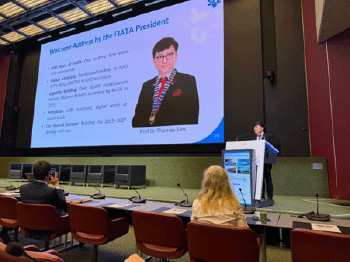 Thomas had actually been omnipresent through the 3+ days of business in Geneva and was clearly engaged at all possible levels. Nonetheless Thomas spared some of his precious time to have a private conversation with me on behalf of the FlyingTypers. Thomas and I have been walking side by side for so many years . . . Thomas had actually been omnipresent through the 3+ days of business in Geneva and was clearly engaged at all possible levels. Nonetheless Thomas spared some of his precious time to have a private conversation with me on behalf of the FlyingTypers. Thomas and I have been walking side by side for so many years . . .
Here is what Thomas told us in private, just after the end of day 1 of the HQ.
I started by observing that the morning session at the opening was as balanced as one could wish in a period when certainties vanish day and day out. What would Thomas Sim’s message be for the forwarding community that is struggling to adjust to this new situation?
This was Thomas Sim’s reaction: “We must accept that uncertainty is no longer a phase: it is the operating environment. In such times, resilience is built not on reacting faster, but on acting with clarity, discipline, and collaboration. Freight forwarders must continue to anchor themselves in professionalism, strengthen partnerships across the supply chain, and uphold trust as the foundation of every transaction. At the same time, we must adapt with purpose: embracing digitalization, enhancing visibility, and aligning with evolving regulatory and sustainability expectations. FIATA will continue to stand alongside the global forwarding community to provide guidance, to advocate and to ensure that our industry remains not only relevant, but essential in navigating this new reality.
The rules of global trade are shifting, and those who succeed will be those who are adaptable, credible and connected. This means investing in digital capabilities, strengthening compliance and operational discipline, and working closely with trusted partners. Most importantly, we must move forward as a collective industry. Through FIATA, we have a platform to shape standards, influence policy, and support each other through this transition. Uncertainty will remain, but so will opportunity for those prepared to lead. Uncertainty is no longer temporary: it is structural.
For freight forwarders, the response is clear: stay credible, stay connected, and stay adaptable. Those who uphold standards, embrace change, and collaborate across the ecosystem will not only withstand this period, but emerge stronger. FIATA will continue to support the industry in navigating this shift with clarity and purpose.
In the various conversations – understandably, geopolitics was everywhere at the FIATA gathering – it was highlighted that Africa might be in a position to gain relevance in logistics, in particular West Africa. I asked Thomas whether he agreed on this as a possible development of the present situation and, in case, what kind of timeline would he expect for this change to come into effect.
Thomas was in agreement with this line of thinking: “Yes, I do believe that Africa—particularly West Africa—is positioned to gain increasing relevance in global logistics. This is not a speculative development, but a structural shift already in motion. Several underlying factors support this trajectory:
Demographic growth and urbanization, driving consumption and intra-African trade
The implementation of the African Continental Free Trade Area, which is progressively reshaping regional trade flows
Increasing investment in port infrastructure and logistics corridors, particularly along the West African coastline
A gradual rebalancing of global supply chains, where diversification beyond traditional hubs is becoming a strategic priority.
President Sim continued, observing that “the pace of this development will not be uniform. In my view, we can expect: in the short term, groundwork to continue with policy alignment, infrastructure development, and strengthening of regulatory frameworks; in the medium term, noticeable growth in regional trade volumes, improved connectivity, and stronger positioning of key West African gateways, whilst in the Long term, Africa, including West Africa, becoming a more integrated and influential node within global supply chains.
However, this evolution will depend critically on governance, infrastructure execution, digital adoption, and capacity building. This is precisely where organizations like FIATA—and engagement from the global forwarding community—can play a meaningful role. By supporting standards, training, digital frameworks and professionalization, we can help ensure that this growth is not only realized, but is sustainable, structured and globally integrated. So yes, the opportunity is real, but it will require collective effort, disciplined development and time to fully materialize.
 |
Thomas is a logistics professional with such a complete view of international logistics, in the various modes and different services, also from an academic point of view, that I also wanted to explore his perception with regard to this aspect of our work. I asked Thomas whether airfreight would stand to gain on other modes after the disruptions, or would multimodal transport through corridors emerge as preferred option.
Thomas contended: “This is not an ‘either-or’ outcome: both airfreight and multimodal transport will play increasingly important, but distinct, roles. Airfreight will continue to gain relevance where speed, reliability, and cargo value are critical. In periods of disruption, we consistently see a shift towards air as businesses prioritize continuity over cost. This is particularly evident for high-value, time-sensitive, and critical supply chains such as pharmaceuticals, electronics, and spare parts. However, what is structurally changing is the growing importance of multimodal transport and alternative corridors. As global supply chains adapt to geopolitical uncertainty and recurring disruptions, companies are actively diversifying their logistics strategies. This includes: developing land–sea corridors and regional trade routes, reducing over-reliance on single gateways or chokepoints, and optimizing cost, transit time and risk through integrated transport solutions. In this context, multimodal transport is not just an alternative: it is becoming a strategic design principle for more resilient supply chains. From a FIATA perspective, this reinforces the importance of standardization, interoperability and digitalization, particularly through instruments such as the electronic FIATA Multimodal Bill of Lading, which enables seamless coordination across different modes of transport.
Looking ahead, Airfreight will remain indispensable for speed and resilience in critical moments, Multimodal corridors will grow steadily as the preferred model for balancing cost, flexibility, and risk, ultimately, the future is not about choosing one mode over another: it is about orchestrating multiple modes intelligently.” I could not resist observing that this is precisely the freight forwarders’ specialty, but Thomas was quicker: “Freight forwarders who can design and manage these integrated solutions will be best positioned to lead in this new environment.”
Just before leaving to another of his myriad tasks at the HQ, Thomas Sim closed this short interview with this thoughtful statement: “In today’s environment, the real challenge is not disruption itself, but the lack of alignment across systems, standards and stakeholders. This is precisely where FIATA plays a critical role. As a global federation, FIATA provides the neutral platform that brings together industry, regulators and international organizations to ensure that, even in times of uncertainty, there is consistency, trust and interoperability in how global trade operates. Without this alignment, fragmentation increases—and with it, cost, risk and inefficiency across supply chains. In a time where global trade is becoming more complex and multipolar, no single player can navigate it alone.
I would encourage all stakeholders—forwarders, platforms, regulators, and partners—to engage more actively with FIATA, not only as members, but as contributors. Because FIATA is not just an organization: it is a collective voice and shared responsibility to shape a more resilient, efficient, and sustainable logistics ecosystem. FIATA ensures that, even in a fragmented world, global trade continues to move with structure, trust and common purpose.”
Thomas, this is no longer part of our interview, but my sincere tribute to a person who has successfully combined personal success in his career as entrepreneur, together with the success of the various endeavors undertaken on behalf of FIATA, in “vocational training” as the term was in those years, then with the FIATA Foundation’s initiatives and now within the Presidency at the helm of FIATA. You are a relentless worker, who is bound to succeed and I am sure the daunting role as FIATA President will be just another of your duties, which are always performed with perfect focus and enviable strength of character.
Looking forward to meeting you and all in Milan in October to celebrate the unique achievement of being 100 years at the head of logistics at the service of international trade, with thanks to all those who made 2026 FIATA HQ so unforgettable!
Marco L. Sorgetti |








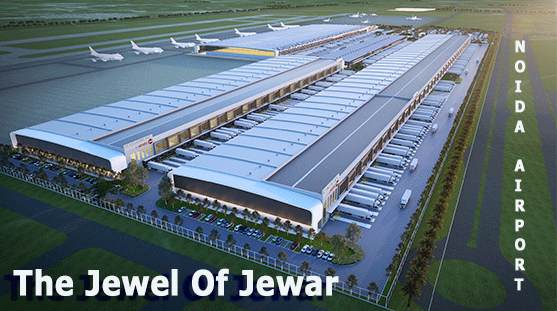
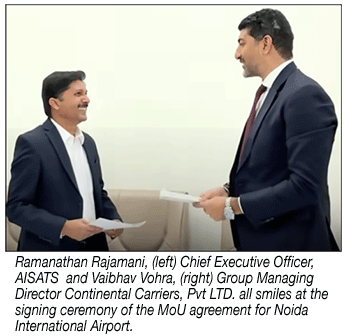 Most recently on February 26, Air India SATS Airport Services Private Limited (AISATS) signed a strategic MoU with Continental Carriers PVT LTD to enable transfer of export cargo to Noida International Airport. Under the agreement, customs-cleared cargo from Continental's Kapashera air freight station will be transported via bonded trucking to AISATS' integrated cargo terminal at Jewar for onward international dispatch.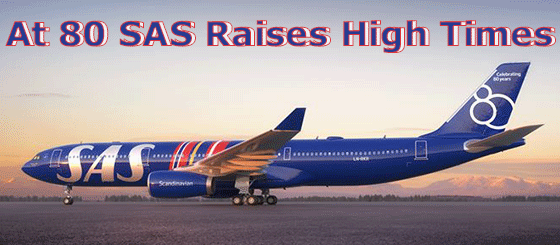
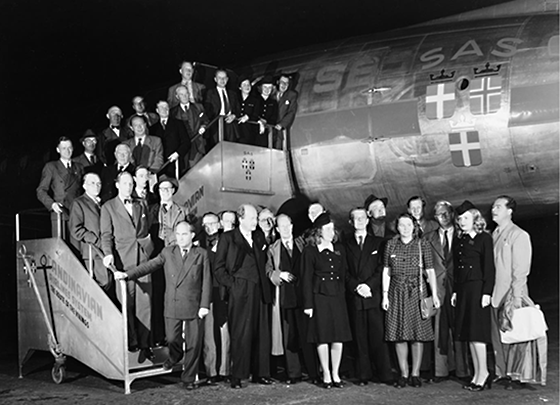
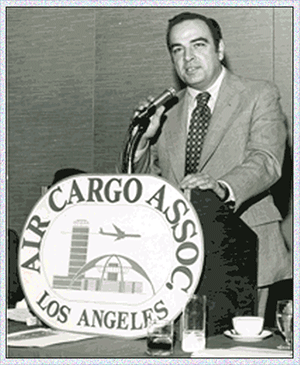 For air cargo in USA, SAS had a standout figure: Jerome “Jerry” Trimboli. He was once described as a “slugger without a bat,” which is a pretty good way to say he didn’t need spectacle to make an impact. He just delivered results—year after year.
 100%
Green
100%
Green