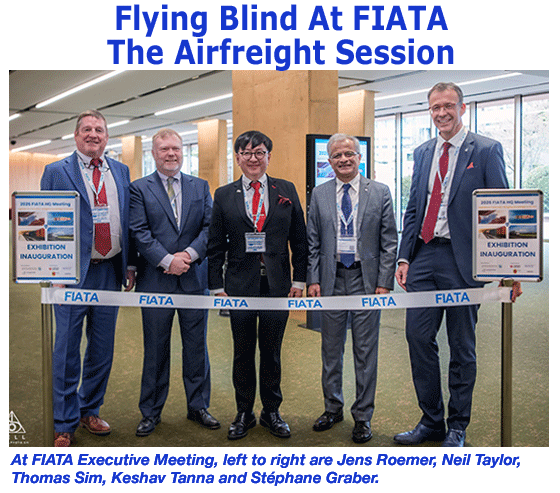
 |
I am now writing during my second day of the FIATA HQ meetings in Geneva about the events that happened on the first day. Everything happens so fast here you would need one thousand hands to keep up, within the meeting and outside . . . Just reading a message from Drewry: “Drewry invites you to a webinar briefing on Wednesday 15 April 2026 to discuss the impact of the Middle East conflict on the container shipping market and its various stakeholders. This webinar will also provide insight into how the industry is adapting to a fast-moving story and what lasting effects it could have to reshape the way it operates in the future, as well as providing guidance on what cargo owners can do to protect themselves from rising costs.” In a way this sounds like a summary of much of the debate taking place here in Geneva. Trouble is . . . by April 15th everything could have changed already. We are obliged to fly blind now and we are even lucky that we can fly at all.
Let me stop moaning and get to the area of main interest for many FT readers, instead: airfreight. This session was divided in two, as customary nowadays: an introductory part and subsequent breakout sessions. In general, this has both positive and negative consequences. For just one pair of ears and eyes, it is a bit demanding, but I shall try my best. The first part gave account of the work done by the Airfreight Institute of FIATA (AFI); interestingly the institution still bears the same historical name, but in my view this is where the “Reset Programme” of FIATA mentioned by Thomas Sim is more visible.
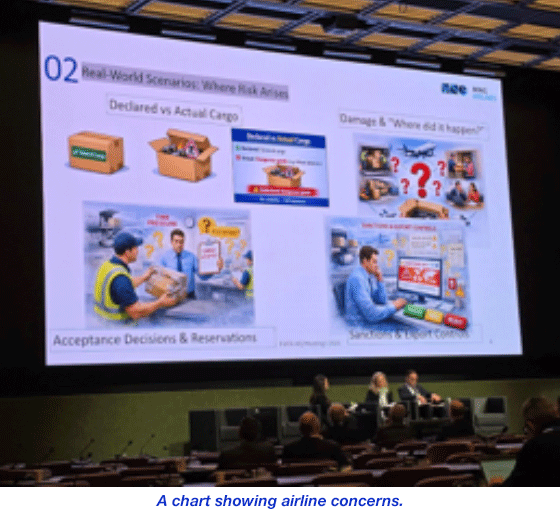
One could say that the same issues seem to remain on the table, those we have been talking about in the last few years: the progress of the Cargo Programme, one step forward and one back, etc. We also listened to a well-crafted presentation that was so persuasive on the various issues that airlines are facing that one almost felt sorry for them. At least these were my first impressions, and I would be glad to stand corrected, were these incorrect.
 |
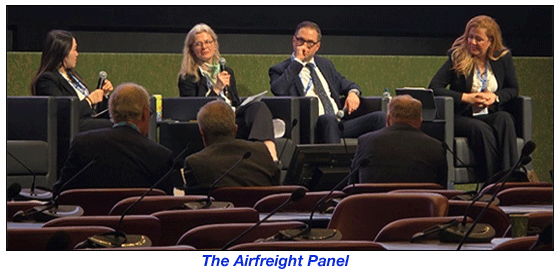
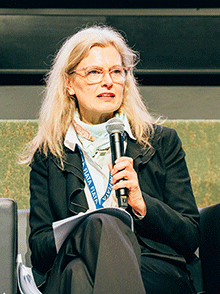 Much of the conversation in the panel was looking at technical details and concerning legal issues, in particular one issue was repeatedly brought to the fore: the role and function of the freight forwarder with regard to the issuance of the air waybill, as principal or as agent of the shipper. This is not a new discussion, but some additional logs were recently added by an IATA resolution that is supposed to take effect in July. Katharina de Résseguier explained the scope of Res 672 from IATA, which deals with the concept of contractual carrier and actual carrier. If there is no clear statement that the FF is acting as an agent, it would be considered then party of the cargo contract [as principal]. Much of the conversation in the panel was looking at technical details and concerning legal issues, in particular one issue was repeatedly brought to the fore: the role and function of the freight forwarder with regard to the issuance of the air waybill, as principal or as agent of the shipper. This is not a new discussion, but some additional logs were recently added by an IATA resolution that is supposed to take effect in July. Katharina de Résseguier explained the scope of Res 672 from IATA, which deals with the concept of contractual carrier and actual carrier. If there is no clear statement that the FF is acting as an agent, it would be considered then party of the cargo contract [as principal].
Keshav Tanna, former Chair of AFI and 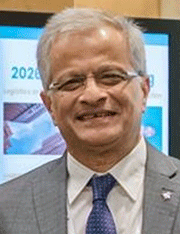 Secretary General of FIATA, observed there are two places in the AWB where the signature can be specified. There are provisions to specify that FF is acting as an agent, if that is the choice. Secretary General of FIATA, observed there are two places in the AWB where the signature can be specified. There are provisions to specify that FF is acting as an agent, if that is the choice.
Listening to the various interventions I captured this statement: “Many operators do not understand in which capacity they are operating.” To be honest, in 2026 this seems to me overstated. I do not discard the idea that some imprudent practitioners might still operate without full awareness of their role, but I maintain this is not FIATA’s fault. FIATA is doing and has been doing for years all that could be done to improve knowledge and awareness; FIATA members in general are pretty well informed about the conditions of the market they operate in, including the legal framework. Wherever the statement came from, perhaps it would have been better to also give credit for the work that FIATA is and has been doing in this regard.
 |
Then the discussion moved on to the pros and cons of arbitration.
 During the Q&A, Barbara Hiebendahl contributed with a factual issue, which has a profound legal nature, i.e. the real-world obligation for freight forwarders collecting cargo to sign for receipt even before seeing the goods, in particular – it was noted – in the USA. In my opinion, this is an aberration from a legal point of view and the message was received almost incredulously by the lawyers in the room. Yet it is one of those facts of life that forwarders often are left to deal with, without counting on any protection. Keshav Tanna again took the floor and explained that FF’s are supposed to give cargo ready for carriage. There is a clear responsibility in this regard. If there is a damage, there must be a proper signature that shows where damage took place and there must a possibility for this kind of remark to be placed together with the receipt signature. During the Q&A, Barbara Hiebendahl contributed with a factual issue, which has a profound legal nature, i.e. the real-world obligation for freight forwarders collecting cargo to sign for receipt even before seeing the goods, in particular – it was noted – in the USA. In my opinion, this is an aberration from a legal point of view and the message was received almost incredulously by the lawyers in the room. Yet it is one of those facts of life that forwarders often are left to deal with, without counting on any protection. Keshav Tanna again took the floor and explained that FF’s are supposed to give cargo ready for carriage. There is a clear responsibility in this regard. If there is a damage, there must be a proper signature that shows where damage took place and there must a possibility for this kind of remark to be placed together with the receipt signature.
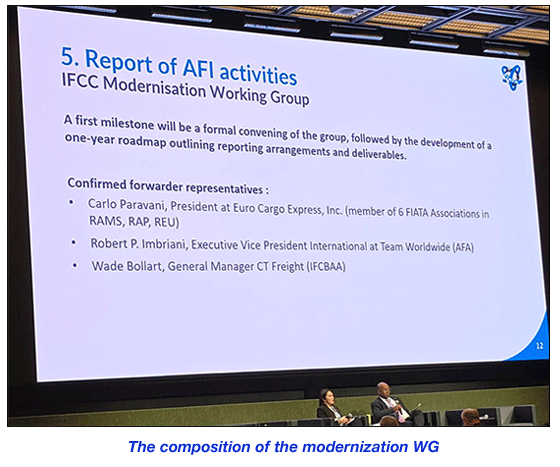 |
Let us move one step further. In the complex landscape of the relationship between forwarders and airlines many of you know that a Modernization WG exists in FIATA. At this meeting there were questions regarding the representation of the delegates (mainly from the USA, was the question), but the DG argued that this is an international programme and the appointments came from several federations in different areas. In fact, Dr. Graber was invariably able to address the many questions regarding the modernization, and there was no visible disagreement in the room.
My thoughts went back to other times in AFI, when other personalities were at the table. Nobody would absorb answers perfunctorily in those years, on all sides. Sometimes I am wondering whether I miss that turbulence. There is no desire for confrontation now, surely not at this point in time, but fact is that progress seems to be slow, to say the least. In any case, Dr. Graber was clear on the fact that there is no way to keep the status quo, if ever that was expected.  The DG and Andrea Tang, the manager in charge, confirmed that FIATA had engaged its national association members to verify the various modi operandi, within its intercontinental constituency, on the impact of these rules in order to be equipped for new and conclusive discussions with the airlines before the summer. The DG and Andrea Tang, the manager in charge, confirmed that FIATA had engaged its national association members to verify the various modi operandi, within its intercontinental constituency, on the impact of these rules in order to be equipped for new and conclusive discussions with the airlines before the summer.
Obviously all that you are reading here is the fruit of my own understanding, by listing to the panel and the conversations: I shall be more than happy to stand corrected if there are any factual mistakes in what I am reporting, or even if any of those concerned think that there are better ways to express these concepts. Anyone who feels that more precision is required is invited to submit comments that will be published literally.
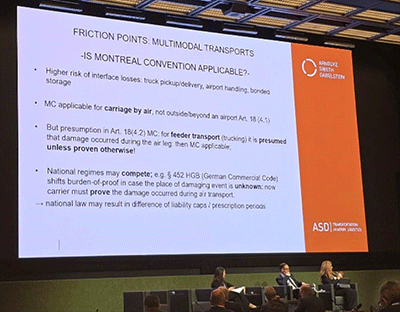
 Listening to the panel conversation, I had the impression the discussion was becoming highly technical from a legal point of view. Legal is an important contribution to knowledge and improvement, but I am personally wondering whether this is the right approach for FIATA when negotiating with IATA. I have a personal credo that the Law is and must be above everything else, but I am wondering whether negotiating with airlines basing your talks on legal is a winning strategy for freight forwarders. If there is a winning area for forwarders, that is performance, measurement and flexibility, with a more commercially effective approach. We have many lawyers in our ranks, but that is not our strength in my view. I shall leave it at that, but I think we should be playing on a level playing field and I do not see that this is the case at this point in time. Stéphane Graber and his team are dealing with a difficult task and they should have all the support that is available. In the end the final result will remain in the records, not the efforts. Listening to the panel conversation, I had the impression the discussion was becoming highly technical from a legal point of view. Legal is an important contribution to knowledge and improvement, but I am personally wondering whether this is the right approach for FIATA when negotiating with IATA. I have a personal credo that the Law is and must be above everything else, but I am wondering whether negotiating with airlines basing your talks on legal is a winning strategy for freight forwarders. If there is a winning area for forwarders, that is performance, measurement and flexibility, with a more commercially effective approach. We have many lawyers in our ranks, but that is not our strength in my view. I shall leave it at that, but I think we should be playing on a level playing field and I do not see that this is the case at this point in time. Stéphane Graber and his team are dealing with a difficult task and they should have all the support that is available. In the end the final result will remain in the records, not the efforts.
Let me now briefly jump to March 31st, something else concerning airfreight was tabled in the sessions devoted to sustainability. There will be more on this second day in another report, but this part connects rather well with what we have said before. It was noted that there is still no strong demand for sustainable shipping, and it was argued that in conclusion we need a global regulation, making it fair for everyone and spreading the cost across the globe. In my personal view expecting fairness from regulation is not a good employment of one’s time. Airfreight is one of the modes that will be heavily affected by regulations on sustainability. The picture appears patchy at this point, but efforts are being made to make a credible plan going forward. More to come on this issue in the coming days.
 In closing, there was a choice on what topic was I to follow next, because the Multimodal Transport Institute’s working groups held their meetings separately. I chose the WG Sea, which seemed to me the most immediately affected by the situation in the Middle East. At one point there was a clear statement that sounded like: “All these things are unpredictable”. And then, it was perfectly clear that the name ‘Cape of Good Hope’, which had been evoked so many times during the day, literally meant its appellation at this point in time! In closing, there was a choice on what topic was I to follow next, because the Multimodal Transport Institute’s working groups held their meetings separately. I chose the WG Sea, which seemed to me the most immediately affected by the situation in the Middle East. At one point there was a clear statement that sounded like: “All these things are unpredictable”. And then, it was perfectly clear that the name ‘Cape of Good Hope’, which had been evoked so many times during the day, literally meant its appellation at this point in time!
The conversation took another turn again and the relationship between forwarders and shipping lines was explained as being as old as our working mission: forwarders’ services originate from providing services to the ship at the port, at least in many areas of the world. In this regard there was a claim for the added value that freight forwarders bring to the table in international trade. One could argue that again this not a new concept, but I maintain that listening to these concepts again and again, at times, when everything seems to be shaken, is actually reassuring and I think many had the same feeling today.
In the end, it is just the same story of Trains and Boats and Planes, so it will probably remain for a long, long time. No wonder we have recurrently heard the same old song.
One could go one step further and take note that making the modal choice, finding the best solution is what makes freight forwarders unique in logistics and trade, in particular when disruptions occur. Could we say that forwarders are symbiotic with the physical carriers and in a symbiosis both parties have their advantages? In nature the symbiosis is a practical solution to save resources and achieve better results.
See what food for thought today’s meetings will bring. I am waiting . . .
Marco Sorgetti
|











 100%
Green
100%
Green