|
A Fast Start On Monday Morning
My dear readers,
As I told you at other times, FIATA is always FIATA, and let me please add, fortunately!
Most of the usual suspects were here, some excuses caused by personal reasons were noted, but no visible disobedience or disappearances. Some excuses due to the situation in the Middle East were duly noted. Obviously there is always a lot to talk about, and a lot of ambitions that manage to surface here or there. Let’s face it, if you are somebody in FIATA you feel you are actually working for making international trade better, a feeling that is partly truthful. But making international trade better seems to be a tall order these days.
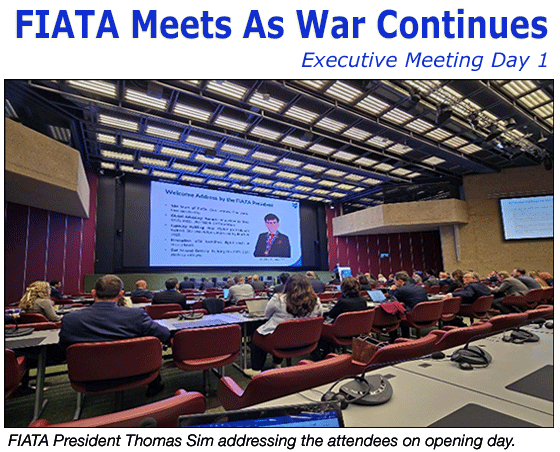
The opening was at 09.00 sharp and the welcome coffee was a good moment to catch up with old friends. Naturally, President Thomas Sim opened the meeting and welcomed the participants. I really appreciated his opening remarks, thoughtful, diplomatic and firm at the same time, a thoughtful message many should listen to. It is probably no coincidence that Thomas is from Singapore, a country that gave FIATA three presidents. Singapore is one of the most important “positions” in trade and logistics and it shows in so many different ways, one of which is its ascension to the helm of FIATA in 2025 for the third time.
Thomas started with a thought for those who could not join us because of difficult transport conditions and unrest. “Not all our colleagues were able to join us,” he said and expressed his wish that their families and their teams are safe. Moving to typical FIATA topics President Sim mentioned that “in 2019 members asked FIATA to reset” the association. In 2020 FIATA moved to Geneva, which was a “deliberate signal that FIATA belongs at the heart of diplomacy.”
The complete list of recent achievements in international relations was given, in particular looking at FIATA’s training activities that have always been Thomas’s piece de resistance. Thomas has been relentlessly promoting FIATA’s training for three decades now, actually one of the most successful activities FIATA conducted in all these years. It was also noted that for the first time a field meeting had taken place in each of the FIATA regions. Thomas also said that “100 years of credibility is worth protecting”, so FIATA took initiative to protect its brand: “regulators will know who stands behind it,” said Thomas Sim. “This is how we build the trust that helps our advocacy.” With the long-lasting commitment of FIATA’s members . . . “let us get into our second century together,” was President Sim’s successful conclusion.
DG Stéphane Graber followed in tune and mentioned the principal achievements of the year, which you may have read in our introductory article. Over and above the digital strategy, the regional matrix etc. there was also a piece of news, at least for me: the recent collaboration with the AON World network.
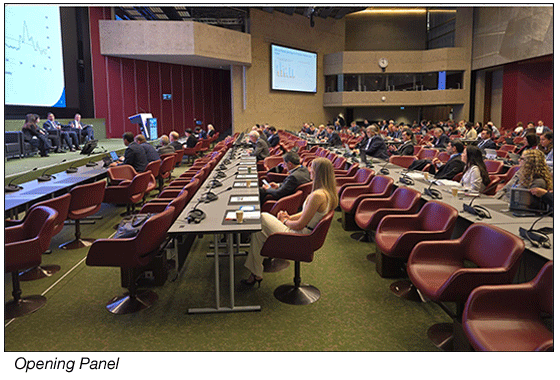 |
Stéphane also introduced and moderated the first panel. His introduction was unsurprisingly clear: “In a world where uncertainty is increasingly become the norm . . . ” There is no need to explain further I expect and the information was, if not forbidding . . . you could have wished to be given better news. At the same time there was a sense of serene contemplation of events and this contributed to everyone’s peace of mind. Dr. Graber also noted that multimodality is becoming more and more important, so 2026 could be ‘the year of FIATA’.
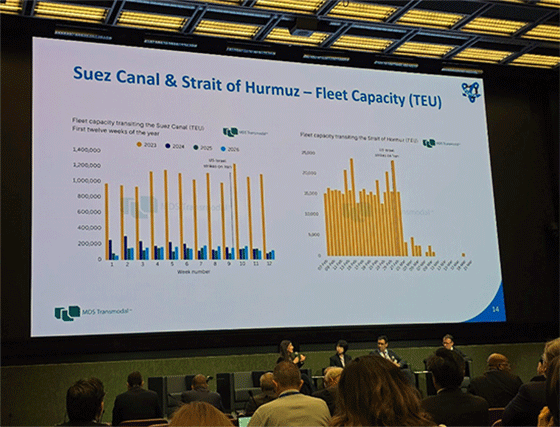 |
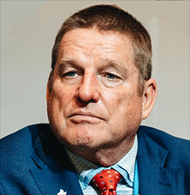 In the panel we were given ample visual evidence of the disruptions in Hormuz and Suez, but on this point let me jump directly to what Jens Roemer had to say during the Press Conference. Jens is SVP of FIATA and former President of the WG Sea, a primary source of up to date information about the situation in the maritime sector connected with the war in the Middle East. In good substance this is what Jens told us with regard to the crisis and Shipping Lines’ role: “FIATA has reacted to the crisis in the Middle East, representing the role of our industry in this situation. There is responsibility in our industry to keep trade and transport fluid even in the most difficult environment. FIATA swiftly published a dedicated Legal and Insurance Briefing with a focus on Contractual and Insurance Considerations for Freight Forwarders; a webinar with 300 participants contributed to the information. Without forgetting seafarers’ well-being and protection, the industry in involved at two levels: In the panel we were given ample visual evidence of the disruptions in Hormuz and Suez, but on this point let me jump directly to what Jens Roemer had to say during the Press Conference. Jens is SVP of FIATA and former President of the WG Sea, a primary source of up to date information about the situation in the maritime sector connected with the war in the Middle East. In good substance this is what Jens told us with regard to the crisis and Shipping Lines’ role: “FIATA has reacted to the crisis in the Middle East, representing the role of our industry in this situation. There is responsibility in our industry to keep trade and transport fluid even in the most difficult environment. FIATA swiftly published a dedicated Legal and Insurance Briefing with a focus on Contractual and Insurance Considerations for Freight Forwarders; a webinar with 300 participants contributed to the information. Without forgetting seafarers’ well-being and protection, the industry in involved at two levels:
 |
Containers caught in transit
Force Majeure has been declared or B/L clauses activated in order to ‘end journeys’, with the consequence that containers have been offloaded in ports of the choice of the shipping lines and left at the care of the cargo interest. Shipping lines have thus dealt with the situation, but for global shippers this is just the beginning of a possible nightmare, in ports unknown to them where they have no contact. It is left to the industry of globally connected Freight Forwarders to pick up the pieces, defending the interest of their customers and dealing with the containers in order to satisfy the needs of their customers in the middle of a crisis.
Jens concluded this point noting that ‘our industry is able to provide solutions where others fail.’ But he also stipulated that in this context, all stakeholders are urged to be fair and respect this very special situation requiring special actions. All stakeholders may have a responsibility to adopt solutions. In this context, it is important that shipping lines offer fair financial terms to help supporting solutions for the containers that are dropped into ports, in particular for demurrage and detention charges.
The second level of involvement regards Containers and cargo to be delivered to GCC countries.
The strait of Hormuz is closed, but the economies need supplies. Container ships are not able to navigate, so we need other solutions, requiring a combination of different modes of transport.
The FIATA Multimodal B/L has first been introduced in 1986, the industry has initiated and developed multimodal transport from door to door as early as 40 years ago. Our industry has come up offering multimodal solutions usually via Oman or the Red Sea. Of course, solutions will also need to take into consideration liability aspects and Customs or transit documentation. Some FIATA members offer these door-to-door solutions covering the whole liability aspects on a single document, which is important. Transport is one thing, but liability is another. “We highly appreciate the proactive move of GCC governments and regulators in their support to look into procedures and regulations in order to improve fluidity: this is an extreme situation that requires fast and practical solutions, to maintain fluidity. We have the solutions to deal with the cargo that cover the transport, liability as well as customs documentation.
On the risk of increases in rates and surcharges, which may affect container shipping as a network business, the disruptions in the Middle East occurred without notice, are substantial and are affecting services negatively. Of course there are higher fuel charges to deal with, but competition authorities are watching when there is a direct impact on consumer prices. This is not the case for shipping lines, however at the end the consumer will also pay for higher shipping charges. There is no system in place that controls the justification and fair level of surcharges. In this context, our sector urges the shipping lines to justify and be fair with the instrument of surcharges. It comes to my mind that Jens’s appeal is strongly backed by the evidence of facts in a moment when one would shout “all hands on deck!” Will he get a listening audience among all the stakeholder?
 Returning a minute to the panel discussion, let me take note of two statements: Antonella Teodoro of MDS Transmodal sent a message by saying that mitigating risk while balancing behaviour will remain, in other words she does not believe that things would go back where they were even if hostilities cease immediately. Dr. Zhang expressed some perplexity on the possible return to the Red Sea. In other words, the panel conveyed the message that the changes we are experiencing are not transitional, but will probably permanently change the landscape of logistics and trade. Returning a minute to the panel discussion, let me take note of two statements: Antonella Teodoro of MDS Transmodal sent a message by saying that mitigating risk while balancing behaviour will remain, in other words she does not believe that things would go back where they were even if hostilities cease immediately. Dr. Zhang expressed some perplexity on the possible return to the Red Sea. In other words, the panel conveyed the message that the changes we are experiencing are not transitional, but will probably permanently change the landscape of logistics and trade.
 In the Q&A session Dawit Woubishet asked to expand on Africa, which appeared to be highly affected by the current situation, in particular regarding fertilizers. Another delegate asked to reflect on the currencies’ situation, which gives no certainty in an even more fragmented world. Antonella Teodoro sustained that the situation would actually favour West African countries, as shipping lines may have more opportunities to stop there, but some caution was eventually poured onto this discussion by other voices. In the Q&A session Dawit Woubishet asked to expand on Africa, which appeared to be highly affected by the current situation, in particular regarding fertilizers. Another delegate asked to reflect on the currencies’ situation, which gives no certainty in an even more fragmented world. Antonella Teodoro sustained that the situation would actually favour West African countries, as shipping lines may have more opportunities to stop there, but some caution was eventually poured onto this discussion by other voices.
During the Multimodal Transport Institute session, the issue of who should bear the cost of the diversion emerged clearly; the solution is not easy, but it appeared impossible to expect shipping lines alone to absorb the difference in costs.
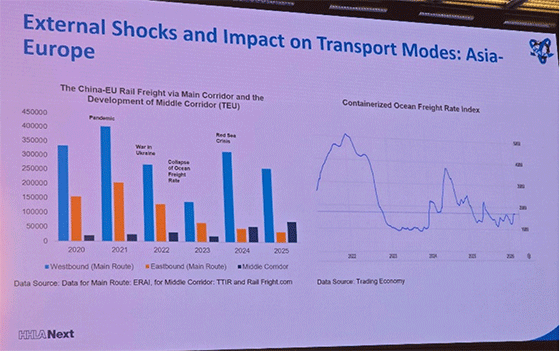
ITCA’s delegate from Iran presented that information about the actual shipper is being demanded more and more regularly, even if this does not appear on regular transport documents; there is no evidence that the information is used to approach customers directly, though and this closed the item, not without taking note that self-filing could assist in solving the problem of quality information. The delegate from Slovakia lamented that there is an issue about phantom road carriers. In a way I considered this good news: this is a clear signal that everything changes in the systems, but the world remains the same . . . The morning came to an end with a panel on the competitiveness of multimodal corridors. The session was clearly informative, but let me limit myself in the interest of time to take note of two elements a) at least for those who have an interest in IT and logistics IT connections, the UNCEFACT standards have become the lingua franca of the Trans Caspian multimodal corridors, as sustained by Mario Apostolov of UNECE; b) OECD has released a performance assessment of multimodal corridors that is well worth reading.
I wish I could go on and give you the account of the Air Freight session, but it is late in the evening. I have been quite busy all day and, yes, I am getting older and must accept this is a fact of life. The airfreight and more will come tomorrow. The session was civilized and interesting for those who followed these discussions in the years.
My opinion: this was a pretty honest account of what happens in the operations of the freight forwarding community in a moment of extreme tension. In a way I am admiring the matter of course approach of the sector in such exceptional circumstances. There is less amusement than usual, even when socializing, which is a pity, but there is possibly even more socializing and this is very positive. The sector seems to be standing firmly on its feet, without too many grievances, keeping the goal in sight and this is more than one could say about other areas of business.
We shall see what happens between this end of March and the beginning of October, when FIATA meets in Milan to celebrate its centennial’s congress. This 100-year-old lady is perhaps worried, but alive and kicking.
Marco L. Sorgetti |






 Vol. 25 No. 13


 100%
Green
100%
Green