 |
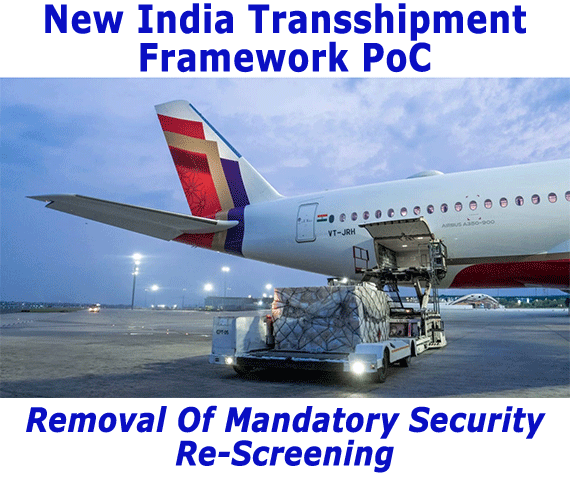
India has taken a significant step to strengthen its standing in international air cargo with the operationalization of a new transshipment framework that allows eligible shipments to stay securely packed during transit, thereby removing the requirement for mandatory piece-level security re-screening at the connecting airport.
Air India began the proof of concept (PoC) on the Chennai–Delhi–Frankfurt corridor on June 20, 2026. The government approved an expansion that could reach five Indian origins and three European destinations, adding to the potential reach of the initiative beyond the original pilot route, after encouraging results.
The reform tackles a long-standing operational constraint in India’s ambition to be a global cargo hub: the extra time and handling involved when cargo arriving at an Indian airport has to be unpacked, screened piece-by-piece and reassembled before being transferred to an onward international flight.
The updated process allows eligible cargo to remain safely packed in the same unit load device (ULD) for the duration of its journey, subject to prescribed security controls. The framework aims to speed up transfers while maintaining security and improving cargo integrity by reducing the need to break down and rebuild shipments at Delhi.
The initial results suggest that the changes could make a material difference to the competitiveness of Indian cargo connections.
Air India reported that average daily cargo volumes on the Chennai–Delhi–Frankfurt corridor increased from 2.2 metric tonnes to 4.5 tonnes during the pilot period. Between June20 and August 20, the airline transported 300 tonnes of cargo from Chennai to Frankfurt through Delhi.
More significantly for freight forwarders and shippers, average cargo connection times at Delhi fell from 36–48 hours to between five and eight hours.
Air India's Flown-as-Booked performance also improved from 76 percent to 100 percent, with the airline reporting no cargo loss or damage during transit. Freight forwarders, including DHL, Dachser, DVS and Kuehne+Nagel provided positive feedback on their experience.
The results point to benefits beyond faster transfers. More predictable connections can improve shipment planning, reduce uncertainty for customers and help airlines make better use of available belly-hold capacity.
The pilot was authorized by the Bureau of Civil Aviation Security (BCAS), which is using the exercise to validate the revised process as the supporting infrastructure is progressively developed.
Following government approval, Air India is extending the framework to eligible shipments originating in Ahmedabad, Bengaluru, Chennai, Hyderabad and Mumbai, connecting through Delhi to Copenhagen, Frankfurt and London Heathrow.
The expansion links several of India's major manufacturing, technology and commercial centres with important European cargo markets. It also gives freight forwarders additional opportunities to route shipments through an Indian gateway rather than relying exclusively on established transshipment centers overseas.
The government has identified domestic-to-international transfers as the immediate focus. The longer-term plan envisages extending the framework to international-to-domestic movements and international-to-international transshipment through Indian airports, subject to regulatory approvals.
This could result in a significant increase in the cargo flows managed by India. However, the scale and timing of that expansion will depend on regulatory clearances, infrastructure readiness and the ability of airlines and ground handlers to maintain consistent operating standards.
Air India estimates that Delhi alone could attract more than two million tonnes of additional annual transshipment cargo across more than 95 addressable international air cargo corridors.
That figure represents potential rather than traffic already secured. Capturing such volumes would require competitive schedules, sufficient handling capacity, dependable connections and close coordination between airlines, airport operators, security agencies, customs authorities and freight forwarders.
For India, the opportunity is to turn its substantial domestic cargo market and geographical position between East and West into a more effective international connecting network.
The new framework could also benefit e-commerce operators, warehousing providers, ground handlers and other logistics businesses by making cargo movements through Indian airports faster and more predictable.
The Chennai pilot has demonstrated what can be achieved on one corridor. The expanded network will test whether those gains can be replicated across more origins and destinations, while preserving the security controls on which the reform depends.
If the model can be scaled reliably, it could help India compete more effectively for cargo currently routed through overseas hubs. The challenge now is to turn a successful proof of concept into a consistent, nationwide transshipment capability.
Tirthankar Ghosh |




 Vol. 25 No. 43
 Vol. 25 No. 44
 Vol. 25 No. 45


 100%
Green