If you have been working in freight forwarding and logistics for 20, 30 or more years, sometimes you have the impression you have seen it all and there is no more that you need to learn. That is actually wrong: if you approach today’s logistics with a curious mind you will soon grasp how different the environment is today from what we used to know. A very good way to touch and feel the concentrate of the current approach to logistics servicing international trade is available to all participants in Milan, IT at the FIATA World Congress. This is not a private gathering for members, but an event where FIATA opens the association’s doors to the whole world. And talking in FATA’s language the entire world means precisely that, probably excluding Antarctica . . .
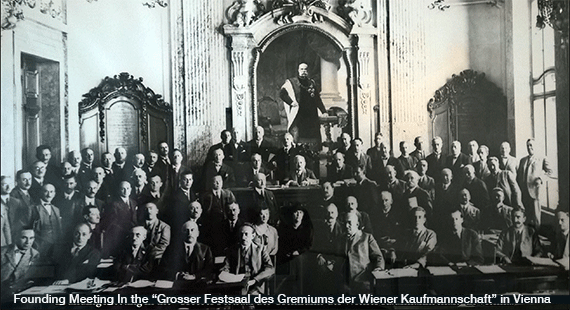 |
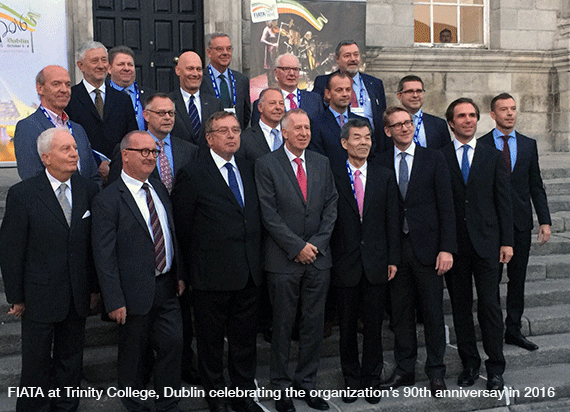
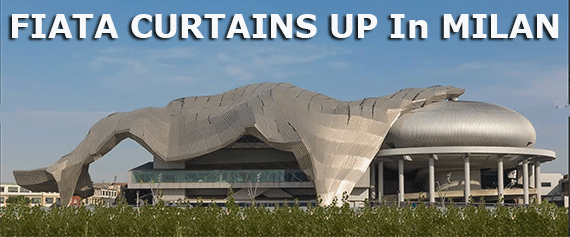
This entire world of logistics is exactly what you will find in Milan opening on Oct 6th, and it is worth your travel, even if you started your journey in logistic 100 years ago, i.e. when FIATA started its own long voyage: its foundation took place in Vienna, AT on May 31st 1926. So there are plenty of business reasons why you want to be there, and one more, fundamental motivation: FIATA celebrates 100 busy years of work at the service of freight forwarders and logistics service providers with a spectacular congress in the capital of Italian business. The Congress will feature the usual combination of business, culture, ethnics, advocacy and policy, but this time, considering Italy is among the top destinations in the world, surely at the top in arts and history with over half of the world patrimony, and topping the UNESCO list, it is hard to imagine a more appropriate location for this centennial celebration. I expect everybody on the scene will be there. Geoffrey Arend, who was nominated FIATA Fellow in 2016, will appear at the Congress having flown all the way from NYC at his now almost venerable age of 85.
 |
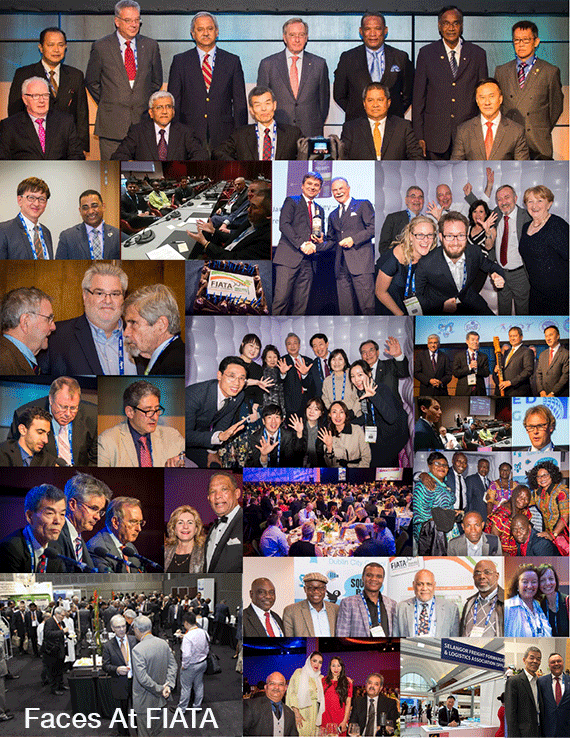
As a result, we shall have the usual problem with FIATA CONGRESSES: the luxury of abundance, even overabundance of topics, comments, business and social events and connections. Whichever direction you are walking, familiar faces, smiling faces, friends and celebrities will become reasons to stop, greet and chat, maybe more, who knows? It will not be easy for us to give account of the free flow of socialising and content that will pour from every session. And the breaks? Even more so, as some of our friends at the UN used to say: sometimes the best deals are reached at coffee breaks. We want to be there and see it with you and for you!
So let’s get a little bit closer to the programme. I asked AI the list of the speakers in alphabetical order and here below is the result. It can be updated after publishing by using the internal hyperlink, as more speakers are listed every day.
Alphabetical Speaker Directory and Session Outlines
- Antonowicz, Miroslaw (Chairman of the Committee, OSJD) – Focuses on global logistics and railway corridor continuity during general/inaugural sessions.
- Cutaia, Marco (Senior Executive, ADM) – Focuses on de minimis tariffs and data processing in Panel 4: Customs Reimagined (Thursday, October 8 | 09:00 – 10:30).
- Ducrest, Azhar Jaimurzina (Chief of Transport Connectivity and Logistics, UNESCAP) – Focuses on supply chain fragmentation in Panel 1: The New Supply Chain Landscape (Wednesday, October 7 | 11:30 – 13:00).
- Joubin-Bret, Anna (Secretary, UNCITRAL) – Focuses on legal frameworks in Panel 1: The New Supply Chain Landscape (Wednesday, October 7 | 11:30 – 13:00).
- Kim, Young Tae (Secretary-General, ITF at the OECD) – Speaks at the Opening Session (Wednesday, October 7 | 09:30 – 11:00) and Panel 1 on "Empowering Global Logistics".
- King, Jaime (CEO) – Covers leadership and enterprise strategy during plenary sessions.
- Kuzmenko, Aleksandr (Secretary General, OTIF) – Focuses on legal integration for rail freight in core sessions.
- Mendelow, Nachi (Senior Business Development Executive & Global Customs Domain Owner, CargoWise) – Focuses on compliance data in Panel 4: Customs Reimagined (Thursday, October 8 | 09:00 – 10:30).
- Punte, Sophie (Founding CEO, Life-Links) – Focuses on climate ambitions in Panel 6: Sustainability in Logistics (Thursday, October 8 | 13:30 – 15:00).
- Rallo, Nicolas (Regional Director) – Covers air freight networks and safety compliance.
- Schultze, Ralf-Charley (Director General, UIRR) – Focuses on intermodal transport bottlenecks.
- Sim, Prof. Dr. Thomas (FIATA President) – Speaks at the Opening Plenary (Wednesday, October 7 | 09:30 – 11:00) on 100 years of logistics standards.
- Verhoeven, Patrick (Managing Director, IAPH) – Focuses on maritime transport and smart ports.
The complete time-slot allocations are available on the FIATA 2026 Official Program Schedule.
This is one of the phrases that AI suggested as a comment to the programme: “For all the emphasis placed on artificial intelligence, electronic Bills of Lading, and cybersecurity protocols during the technical tracks, the exhibition floor reinforces a timeless industry truth: global logistics remains fundamentally driven by human relationships and mutual trust.” We shall see later that I take a similar, but not identical look at this point. AI also suggested a title for the Congress, which I think it is worth mentioning, because it says more or less the same as FIATA’s own congress motto “Empowering Global Logistics” in three times as many words: Transitioning Knowledge into Action at the FIATA Centennial Congress. This interpretation though further explains the situation we live in 2026, when logistics is moving from a people’s industry (as we all love to label freight forwarding) to a people’s industry functioning with AI and other IT tools. I wonder: we started many years ago working on the standards for the industry to move into the digital world, then came more sophisticated systems that could work around the penury of common standard to achieve a seamless supply chain. Now my question, and I hope this debate in Milan will provide an answer, remains: will these new tools allow us to create a seamless logistics work environment where each and every SC stakeholder has its place and function without any communication barrier? Or will this be the instrument to create a big logistics and trade superpower that eventually erodes any kind of competition, big or small as it might be?
Working on the programme in dialogue with AI as an imaginary counterpart, I tried to nail down the main points of my expectations regarding today’s dialogue in logistics, as seen through a FIATA delegate’s eye.
The Centenary Milestone – Legacy, Resilience, and more
As FIATA marks its historic 100th anniversary in Milan, the global freight forwarding community finds itself at a defining crossroads where legacy standards must be rapidly adapted to survive unprecedented structural disruption. We can look at FIATA, in this regard, as the federation's legacy not only provides a retrospective look at standard-building, but as the bedrock upon which modern global freight documentation and trust are built. Can we forget that in the 1950’s and 60’s FIATA directly contributed to the creation of the UN Layout key, which is the basis of nearly all standard trade documents in the world?
The reality is that legacy standards are being tested by modern friction points. To be honest this has always been the case and we are just part of an eternal river of actions flowing from its origin (which we think we know) to its destination point (which we definitely do not know).
Some argue that true "empowerment" is no longer about moving assets safely: it is about providing logistics operators with the tools to manage unprecedented structural uncertainty. The perception of living unprecedented structural uncertainty is probably an evergreen for any period in human history: I had the same impression when I started working over fifty years ago and I guess others must have had an even more justified similar feelings during and after the industrial revolution, or when the Romans provided their cities with current, clean water, or in any other significant period of change. Logistics is changing, true, but it has been changing all the time. Containers changed logistics for good, starting about 65 years ago, and we are more or less all here to talk about it. I really do not believe that any of the participants in Milan can claim that this is the period when change is more evident than ever before. We just talk about it much more. That is my point of view – happy to stand corrected.
There is one additional aspect that I appreciate with a different slant from what AI was suggesting. In anchoring this centennial celebration in Milan, which is one of Southern Europe’s premier logistics and air freight hubs, the FIATA Congress not only shifts its focus from a retrospective look at the past century of FIATA’s history toward an actionable strategy for the future, but it shows that change has indeed many different aspects. Milan has been able to maintain its trade and commerce appeal for centuries (does the name Lombard street in London ring a bell?), but it has also evolved from a fairly grey and unappealing city where people were often reluctantly drawn just to find a job, morphing into a desirable (hence expensive) international business and culture hub, where people are attracted like a magnet.
Navigating Fragmentation – Customs Reimagined and e-Commerce Realities
The recently published September 2026 issue of FIATA Review explores the changing Customs landscape and the challenges facing businesses and logistics operators in 2026. With global trade continuing to grow, albeit at a more modest pace, freight forwarders are increasingly required to navigate rapidly changing trade policies while maintaining efficient, compliant and resilient supply chains. Customs authorities, border agencies, carriers, ports, brokers, warehouse operators and logistics providers all contribute to ensuring goods can move efficiently while meeting regulatory requirements. Please read Mr Jaime King’s article in the latest FIATA Review and prepare for this conversation, it will be interesting.
In any case, the modern freight forwarder no longer operates in a predictable multilateral system and must instead navigate a deeply fragmented landscape of unstable tariffs, shifting trade lanes and exploding, if slightly more unstable, e-commerce volumes. And nobody knows whether this patched picture, which is already difficult to navigate as is, will get worse at the blink of an eye. I wonder, if Madonna were a young adult today, would she sing ‘Living in the whimsical world’?
There is a claim that globalization is dead and classic supply chains break into regional blocks under tariff pressures, but e-commerce growth does not seem to wane, nor can we expect to reindustrialize areas that have been undergoing deep changes for decades and no longer have the skills and human power to sustain the process. Insights from Panel 4 on shifting de minimis thresholds and electronic cargo declarations might help us explore the path which trade has taken. I wonder whether the panels dealing with these items will find out that international trade will reshape itself as a karstic river, reappearing all of a sudden in different, unexpected places. As I had observed in another article on DAWB a few weeks ago, there are expensive compliance costs for forwarders, which must find a return one way or another and the only way this will happen is by allowing a thriving international trade environment to exist, so that global trade acquires additional speed and facilitation through enhanced data accuracy.
 |
The Young Logistics Professionals (YLP) Talk Show
There are many aspects in FIATA’s mission that are – simply put – laudable, but there is one where FIATA has been a shining excellence for decades: its successful training activity, which operates at different and interconnected levels globally. The future of freight logistics is being shaped by a new generation of professionals bringing fresh perspectives, practical experience and new approaches. FIATA is best placed to shine as the guiding light of this evolution.
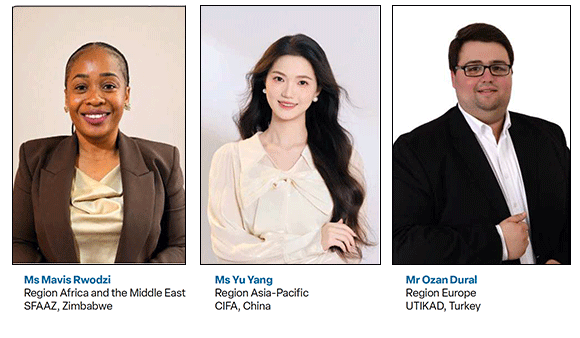
In the mentioned September 2026 issue of the FIATA Review, FIATA speaks with the three regional winners of the FIATA Young Logistics Professionals (YLP) Award: Ms. Mavis Rwodzi, Region Africa and the Middle East (RAME) winner, Ms. Yu Yang, Region Asia-Pacific (RAP) winner and Mr. Ozan Durak, Region Europe (REU) winner. Their paths into logistics are diverse. From banking and international trade to joining a family logistics business and developing expertise across sea freight and foreign trade, each finalist has built her or his career through hands-on experience, professional development and a strong interest in the challenges facing global supply chains. Ms. Mavis Rwodzi examines the balance between economic development, ethical responsibility and responsible trade. Ms Yu Yang explores the integration of multimodal freight transport with energy conservation and emissions reduction. Mr. Ozan Durak focuses on the concept of the “Supply Chain Architect” and how technology can help logistics companies anticipate and mitigate operational risks. FIATA has shown considerable stamina in its collaboration with the TT Club in organising this vast exercise for many, many years, even when the third party in this endeavour, which I do wish to mention now, threw the sponge. All three finalists will come together at the 2026 FIATA World Congress in Milan, where they will have the opportunity to present their work.
What else? The Airfreight session deals inter alia with FIATA’s pressure for clarity on DAWB changes and their impact on Freight Forwarders. Those of you who read my previous article already know what I think about the issue. This being said, FIATA participated in the recent Canadian Air Cargo Program Joint Council meeting on Sep 14th, where extensive discussions took place on the forthcoming changes to the Direct Air Waybill (DAWB) framework. I extracted some information from FIATA itself and this is what I summarised. Participants raised numerous practical, legal and operational questions regarding how airlines and the International Air Transport Association (IATA) intend to implement the new requirements and address their consequences for freight forwarders and shippers.
You already know that several entities, including the Shippers’ Council, are not impressed with the idea that every airline may adopt different modus operandi. FIATA highlighted that it considers IATA’s representation to be incomplete and misleading, without sufficient consideration for the significant legal, operational and commercial implications for freight forwarders and their customers. FIATA also recalled its request to postpone the implementation date until October 2026 and questioned the basis for the accelerated entry into force of the changes. Despite FIATA’s intention to remain committed to engaging constructively with IATA and airlines to identify practical solutions, it remains to be seen whether IATA will respond accordingly. I guess we shall all know a bit more about this teething issue in Milan next week.
What’s next? Ethiopia. This is where FIATA travels next year for the WC of 2027 – 101 years from inception. FIATA visited and reviewed the local core infrastructure, venue capacities, and accommodation options. There were meetings with local authorities, institutional partners and hospitality representatives to coordinate logistics, security, and event planning. Needless to say, the Ethiopian association will invite you to witness their presentation in Milan soon. So be ready for the experience. And… do not forget that FIATA continues to make significant progress in digitalisation; a particular focus on advancing the adoption of the electronic FIATA Bill of Lading (eFBL) in Ethiopia saw collaborative efforts with local logistics associations and software providers, to integrate the eFBL framework into the regional supply chain architecture.
What else? There is so much more to be listed, there are so many more reasons of my heart and my brain that suggest that I need to be in Milan this week, but . . . I am not too well and for the first time in my life I really felt old and impaired in my movements, like never before. My joints and bones have never been famous for performance, but this time it is a bit harder.
I shall anyway travel to Milan; one could say: not a big deal as you live in Turin (120 k’s away). Actually much depends on how you feel, as most of our experience is touch and feel, which is precisely what is not working with me now. I shall be there and try to participate in 100 years of FIATA body and soul (or what remains of it). It’s not contagious, please join me and shake hands!
Marco Sorgetti |




 Vol. 25 No. 38
 Vol. 25 No. 39
 Vol. 25 No. 39


 100%
Green
100%
Green