
 |
India is moving to make its airports more competitive as air cargo transit hubs, expanding a transshipment network after a pilot project demonstrated that removing mandatory re-screening can cut cargo transit times dramatically.
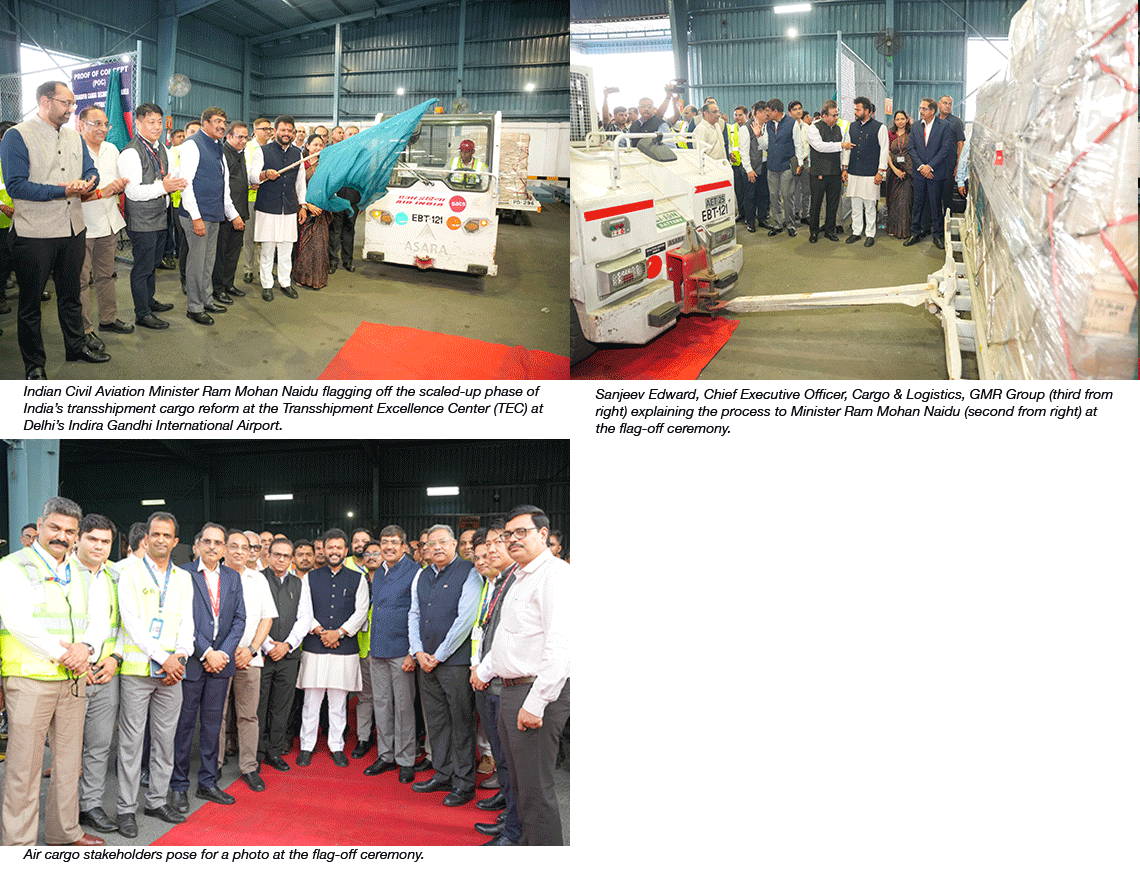
Civil Aviation Minister K Ram Mohan Naidu on August 19 launched the scaled-up phase of the program at Delhi International Airport's Transshipment Excellence Centre (TEC), adding Bengaluru, Ahmedabad, Mumbai and Hyderabad as domestic origin stations and London and Copenhagen as international destinations.
The expansion follows a proof of concept on the Chennai–Delhi–Frankfurt route, launched on June 20 with Air India operating the service end-to-end. Around 280 tonnes of cargo has been transshipped through the Delhi facility since the pilot began. Average end-to-end transit time fell from approximately 60 hours to 20 hours, while aircraft capacity utilization rose from 75 percent to almost 100 percent.
The key regulatory change is the removal of mandatory re-screening for eligible secured transshipment cargo at the transit airport. Instead, cargo can move through dedicated Transfer Cargo Security Hold Areas (TCSHAs), subject to security safeguards.
The move follows after a revised framework was issued by the Bureau of Civil Aviation Security (BCAS) in July 2025. Addendum-II to AVSEC Circular No. 6/2024 prescribing the security requirements for Secured Transshipment Cargo to be moved through TCSHAs without re-screening.
The objective is to do away with a procedural bottleneck without compromising cargo security. In the past cargo changing flights could be subject to a further screening process at the transit airport, adding time, handling requirements and cost. For time-sensitive shipments, the additional process could erode the commercial logic of routing cargo through India rather than through established regional hubs.
The pilot indicates the scale of the potential improvement. The Ministry expects Air India's monthly cargo carriage on the selected routes to increase from 1,763 metric tonnes to 3,183 tonnes as the expanded network is implemented — an increase of nearly 80 percent.
Naidu said the immediate focus remains on domestic-to-international transshipment, but the government's larger objective is to establish India as a global cargo transshipment hub by exploiting its geographical position between eastern and western markets.
The next phase is expected to extend the framework to international-to-international and international-to-domestic cargo movements. The government is also attempting to remove friction beyond security screening.
In April 2025, the Central Board of Indirect Taxes and Customs (CBIC) waived the transshipment permit fee and introduced simplified procedures for the temporary import of unit load devices. Air carriers and console agents can temporarily import ULDs outside customs areas under a continuity bond, while online filing of transshipment applications through ICEGATE has reduced the need for physical interaction with cargo offices.
The measures form part of a broader effort to develop Indian airports as transit hubs. Naidu said the government was applying lessons from the development of passenger hub-and-spoke operations to air cargo.
That strategy is significant because India has historically been stronger as a cargo origin and destination market than as a transit point. Cargo generated in India's manufacturing centres, pharmaceutical industry, agricultural sector and growing electronics ecosystem frequently moves through established hubs elsewhere in Asia and the Middle East.
A functioning domestic-to-international transshipment network could change that equation by allowing cargo originating in Indian cities to be consolidated at an Indian hub and transferred to international services without undergoing unnecessary reprocessing.
Delhi is currently at the center of the experiment. DIAL's TEC provides the dedicated infrastructure, while Air India has supplied the initial operating network. BCAS, CISF, Customs and other stakeholders have been involved in implementing the framework.
The government now plans to add more domestic origin stations and international destinations in the coming months. The challenge will be to translate the pilot’s results into a commercially viable network. India’s geographical position gives it a natural advantage, but competing hubs have spent decades building dense international schedules, sophisticated cargo infrastructure and predictable transfer processes. Regulatory reform can remove a barrier; it cannot by itself create the flight connectivity needed to sustain a global hub.
The early evidence, however, is encouraging. A reduction in transit time from 60 hours to 20 hours demonstrates what can happen when cargo is allowed to retain its security status through a controlled transfer process.
For India, the ambition is no longer simply to handle more cargo. It is to make that cargo stop — and move on — in India.
Tirthankar Ghosh
|





 Vol. 25 No. 36
 Vol. 25 No. 37


 100%
Green
100%
Green