 |
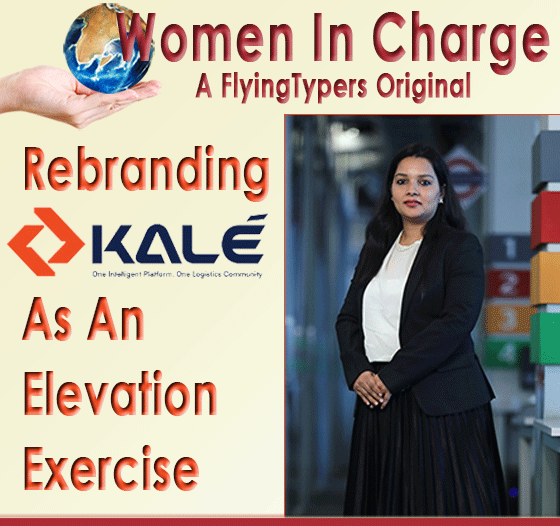
Rajni Patwardhan, Head of Marketing at Kale Logistics Solutions, is a person who feels no trouble dealing with new, challenging concepts, even when starting from a very high level already.
Most of our readers and most of the experts in air transportation and air cargo are well aware of the importance of KALE Logistics solutions for our sector, so Rajni’s departure point is set at a high level, probably higher than many of her competitors. This does not prevent her from candidly declaring in public: “There’s a lot to love about being a modern marketer. Our profession is getting more creative and more technical at the same time. Driven by data more than ever, we are making the subject marketing more objective and goal based. The cool part of my job is do new every day. We meet meaning, emotion and results that matter with creative marketing.”
At FT we had the opportunity to ask Ms. Patwardhan to expand on her thoughts about rebranding the KALE Logistics image, which was disclosed at the end of February. Ms Patwardhan was delighted to take the opportunity: “The rebranding was driven by Kale’s evolution over the years and its promise to the world. We have transitioned from being a technology solutions provider to a global enabler of connected digital ecosystems for logistics. The earlier identity no longer reflected the scale, sophistication, and direction of the company. The new brand is designed to embody intelligence, collaboration, innovation and domain authority. The identity also shows us as a new age product company,” was Ms. Patwardhan’s opening statement.
Obviously there was a bit more to explain regarding the specific message Kale would like to get across to the world: “The key drivers were our global expansion, the maturity of our platforms, and the increasing need for integrated, data-driven logistics ecosystems. The message we want to convey is that Kale is at the forefront of this transformation and evolution—enabling smarter, more transparent, and highly collaborative trade environments. We are not just digitizing processes: we are building the digital backbone of global logistics.”
The new image that is released to the world includes a logo change, which is a rather meaningful move, both professionally and even emotionally for Kale. In the easy and relaxed conversation, even this point was taken with a graceful lightness, yet carrying a powerful and meaningful determination: “Professionally, it represents a milestone; it aligns our identity with the scale and impact of what we deliver today. It signals confidence, clarity, and leadership in our space. Emotionally, it reflects pride in the journey and the collective effort of the teams who have built Kale into what it is today. It’s both a reflection of our past and a statement of our future ambitions.”
 |
We then turned to contemplating Ms. Patwardhan’s career and the firm lady’s personality became then visible when she acknowledged the role Kale Logistics played in her professional development, being cause and product of the same single effort: “The opportunity to build and shape something meaningful has been a key inspiration for me at Kale. What truly drives us is our shared purpose—that through logistics, we are saving lives, moving the world, and facilitating global trade. Kale has always encouraged ownership, innovation, and the ability to experiment. That environment has allowed me to grow alongside the brand.” All this without forgetting the origins, which are always part of the acquired vision of all professionals who arrive at a similar point in their careers: “Coming from a communications and marketing background, I’ve always focused on simplifying complexity. In logistics and technology, the challenge isn’t just building robust solutions—it’s making them understood, relevant, and adoptable. My role has been to drive awareness, shape the market, and craft compelling narratives that position Kale as a trusted leader while reinforcing its vision and impact across the industry.”
We were struggling . . . This lady was smilingly invulnerable to any temptation. Out of the blue we asked: “What concerns you more: the joy of victory or the agony of failure?” Fishing for trouble, we were given a small lesson in savoir faire: “Both are integral to the journey. Success validates direction, while failure sharpens it. What matters is the ability to learn and evolve.” Blessed words! That is a deserved comment, I daresay.
Rajni Patwardhan is clearly a successful professional, and she is a woman. At FT we have always tried to understand the subtle balance that exists for women to attain success, at times with more difficulty than for their male counterparts, whilst sometimes this success remains in good substance unchallenged when achieved, as if it had attained a different, more reverential level. We were curious to explore this point with our guest, who is clearly enjoying complete success in her endeavours. Was there a different sensibility in women marketing new technologies that we should become aware of?
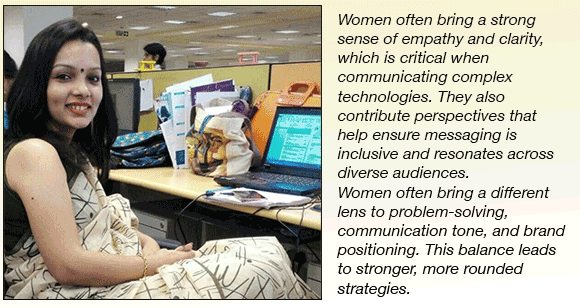
Rajni’s answer was adamant: “Absolutely. Women often bring a strong sense of empathy and clarity, which is critical when communicating complex technologies. They also contribute perspectives that help ensure messaging is inclusive and resonates across diverse audiences. Women often bring a different lens to problem-solving, communication tone, and brand positioning. This balance leads to stronger, more rounded strategies. A balance of analytical thinking and emotional intelligence is a combination which allows for more nuanced storytelling and stronger stakeholder engagement. In logistics, diversity brings better perspectives and better decisions. Logistics, being a highly collaborative industry, stands to benefit greatly from inclusive leadership and diverse voices. At Kale we have around 37% of our workforce to be women. This being said, I would value conversations with leaders who have built global brands and ecosystems—especially those who have navigated scale while maintaining clarity of purpose. And this whether they are male or female.” We agreed: if there is something to learn, the gender of those you learn from is not so important in the end.
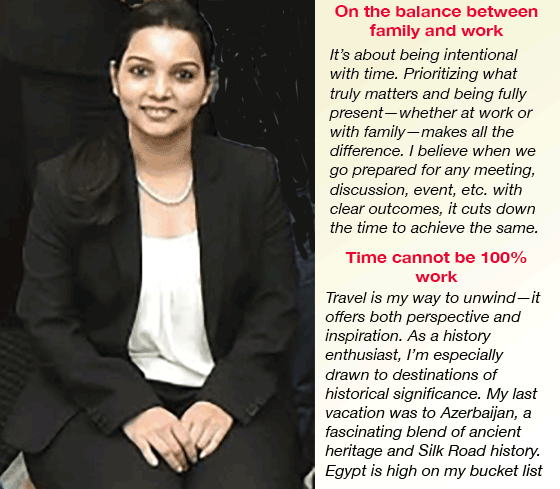 |
Inevitably (?) this conversation touched on the balance between family and work . . . Curiously this is question we normally ask when we speak to women, and rarely do we do so when speaking to male personalities. This only goes to show how profoundly gender-unbalanced our thinking is, even if we do mean the opposite. Anyway, we are honest and we do not wish to hide our question behind one finger: “What time management advice can you give?” we asked and promptly we got our appropriate lesson: “It’s about being intentional with time. Prioritizing what truly matters and being fully present—whether at work or with family—makes all the difference. I believe when we go prepared for any meeting, discussion, event, etc. with clear outcomes, it cuts down the time to achieve the same.” It really is about being focussed, we thought, and women remain focussed even when they are dealing with many issues at the same time. In a way this was a lesson indeed, one of those we were talking about just above.
The conversation was then clearly becoming less technical and more personal. “Your time cannot be 100% work,” we said and this opened a window of fresh air into the so far serious and constructive conversation: “Travel is my way to unwind—it offers both perspective and inspiration. As a history enthusiast, I’m especially drawn to destinations of historical significance. My last vacation was to Azerbaijan, a fascinating blend of ancient heritage and Silk Road history. Egypt is high on my bucket list for a while.”
In cauda venenum, we decided to offer our skin to the bite: “What is your view of media in air cargo?” Again we were imparted a lesson in savoir faire and grace: “The industry media has an important role to play, especially in storytelling. Beyond reporting developments, there is an opportunity to highlight transformation, innovation, and the human side of logistics. That’s where stronger narratives can emerge.”
We cannot but agree. Again this is a good lesson. It actually means: “we are the industry and your role as journalist is to tell the industry’s story.” The real masters of the industry invariably appreciate those who can tell their story well and make is sound appealing to the reader.
In a world where not all journalists are ready to stick to their vocational role, and wish to sometimes tell the industry what it should do, we don’t: we prefer to tell the story as we hear it, and we hope we are doing our job in writing in the way the industry and its stakeholders should wish to read it.
Marco Sorgetti/GDA |









 100%
Green
100%
Green