

#INTHEAIREVERYWHERE

Wednesday May 13, 2026

|
#INTHEAIREVERYWHERE |
|
| Vol. 25 No. 24 | Wednesday May 13, 2026 |
|
|
||
|
The Quiet American |
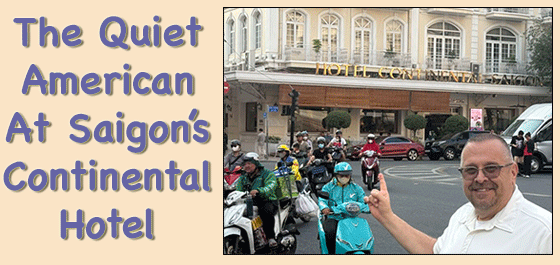
You know that strange, almost physical moment when you come across a photo and, without warning, you find yourself thrown back decades in time? One image and everything comes rushing back. A face, a street, a smell. So, what’s the photo here? An old air cargo pro, Mike Oslansky, in Ho Chi Minh City. He’s standing there in front of a building, calm smile, thumbs-up. And that thumbs-up says it all: he’s doing well, he’s still in the game, and he’s coming up on … what, forty years in air cargo? The kind of guy who’s seen every era go by. The planes, the routes, the methods, the crises … and he keeps going. So, of course, am more than happy for Mike. But what also stirs things up and gets me going is what’s behind him. The Continental Hotel. And even though today people say Ho Chi Minh City, the name on the façade tells of another era. On the pediment, on the awning above the entrances, you can still read “Continental Hotel de Saigon.” And suddenly, it’s no longer just a recent photo. It’s an open door onto a city layered with stories. Once upon a time, when we were posted in Vietnam for our all-expenses paid, 13-month tour courtesy of the U.S. Army, the Continental Hotel on the corner of Rue Tudo built in 1880 was the place we hung out any time we had a pass. At that time, Hotel Caravelle across the street was the glitz of Saigon (if you might call it that) during the 1960s. But we just loved the slightly faded antebellum luxury and mystery of the Continental, that was central to Graham Greene’s 1955 novel, The Quiet American, serving as primary setting for the story and was also a real-life writing location for the author. Continental was a hotspot for spies, journalists, and diplomats in the 1950s. Graham Greene lived in room 214 during the early 1950s, while writing his novel. The hotel’s terrace bar, nicknamed "Radio Catinat," is where the protagonist, British reporter Thomas Fowler, drinks, people-watches, and meets the idealistic American CIA agent Pyle. The Quiet American’s tense political atmosphere, revolving around the decline of French colonial rule, was beautifully captured through the hotel's bustling, cynical, and cosmopolitan atmosphere. Thanks, Mike … GDA |
If
You Missed Any Of The Previous 3 Issues Of FlyingTypers Access complete issue by clicking on issue icon or Access specific articles by clicking on article title |
||
 Vol. 25 No. 21 Brandon 2026 Channels Dylan 1947 Dire Straits On The Elbe Chuckles for April 29, 2026 Intermodal South America Innovative Frosti The Cargo Man |
 Vol. 25 No. 22 Jacques Ancher—A Dutch Master Reimagined Air Cargo |
 Vol. 25 No. 23 Six For American Airlines Cargo Speedy Wonder Cargo By Water Chuckles for May 7, 2026 Buffalo Says Skål To Sweden When Most of Pan Am Became United |
Publisher-Geoffrey Arend • Managing
Editor-Flossie Arend • Editor Emeritus-Richard Malkin |
Send comments and news to geoffrey@aircargonews.co
|


 100%
Green
100%
Green