

#INTHEAIREVERYWHERE

Wednesday April 22, 2026

|
#INTHEAIREVERYWHERE |
|
| Vol. 25 No. 19 | Wednesday April 22, 2026 |
|
|
||
|
Shadow Over India Skies |
The conflict in Iran is causing problems for India's export industry. Air routes are being changed, which means shipping is getting more expensive. This also shows how much India relies on Middle Eastern routes for trade. As the conflict worsened, airlines in West Asia operated fewer flights because of airspace limits and worries about safety. Airlines in the Gulf, which usually handle a lot of India's cargo, are the most affected. This results in a shortage of space for air freight.  Shesh Kulkarni, Managing Director – India at Noatum Logistics, said, “Middle Eastern carriers – Emirates, Etihad, Qatar, and other Gulf carriers have over the years become a strong alternative for cargo movement. With these disturbances their capacity is out of circulation and the impact of this is visible on supply and demand in the marketplace,” Kulkarni said. Shesh Kulkarni, Managing Director – India at Noatum Logistics, said, “Middle Eastern carriers – Emirates, Etihad, Qatar, and other Gulf carriers have over the years become a strong alternative for cargo movement. With these disturbances their capacity is out of circulation and the impact of this is visible on supply and demand in the marketplace,” Kulkarni said. “Demand for space is high and availability of space is low, as a result of which the air freight rates in the market are going through the roof. In certain instances, rates that were around INR 350 to 400 per kg are moving at INR 1600 per kg. All industries such as garments, automotive, pharmaceuticals and FMCG are heavily impacted,” Kulkarni pointed out. The disruption is particularly damaging for export sectors that depend on rapid logistics cycles, including pharmaceuticals, perishables and ready-made garments.  Dinesh K. Krishnan, National Treasurer of the Air Cargo Agents Association of India (ACAAI), said the crisis has created what the industry describes as a “capacity shock” for Indian exports. “The escalation of the Iran conflict has triggered an immediate capacity shock for Indian exports. Perishables such as fruits, vegetables and seafood are the hardest hit because they rely on daily milk-run passenger flights to the Middle East, which are now severely disrupted,” Krishnan said. Dinesh K. Krishnan, National Treasurer of the Air Cargo Agents Association of India (ACAAI), said the crisis has created what the industry describes as a “capacity shock” for Indian exports. “The escalation of the Iran conflict has triggered an immediate capacity shock for Indian exports. Perishables such as fruits, vegetables and seafood are the hardest hit because they rely on daily milk-run passenger flights to the Middle East, which are now severely disrupted,” Krishnan said. He highlighted that “with air freight rates having doubled globally, cargo to the U.S. and EU is increasingly being rerouted via Far East hubs or through direct flights that bypass the conflict zone entirely.” He also added that if the conflict continues, airlines based in the region may reposition aircraft to safer locations. “If the crisis continues, Middle East carriers will likely reposition their fleets to safer hubs outside the region to ensure aircraft safety and utilization. For sectors like pharma and readymade garments, this means navigating limited space and surging costs,” Krishnan said. The disruption has also begun to ripple through India’s manufacturing supply chains, particularly in sectors that rely heavily on petrochemical inputs sourced from the Gulf. 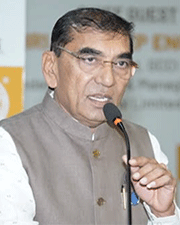 Ashok Jirawala, Vice President of the Southern Gujarat Chamber of Commerce and Industry, said the geopolitical tensions have already triggered a sharp rise in crude oil prices, significantly increasing costs for India’s textile industry. “This recent war-like situation related to Iran has led to a significant increase in crude oil prices in the international market, which is directly impacting the textile industry,” Jirawala said. Ashok Jirawala, Vice President of the Southern Gujarat Chamber of Commerce and Industry, said the geopolitical tensions have already triggered a sharp rise in crude oil prices, significantly increasing costs for India’s textile industry. “This recent war-like situation related to Iran has led to a significant increase in crude oil prices in the international market, which is directly impacting the textile industry,” Jirawala said. “Before the conflict, crude oil prices were around USD 60 per barrel, but after the escalation they have reportedly risen to USD$114 per barrel.” The increase in oil prices is particularly significant because petrochemical derivatives are a key component of synthetic textile production. MEG, made from crude oil, is key for making polyester yarn. This yarn is then turned into fabric and, finally, clothing. According to industry estimates, around 60 percent of India’s MEG demand is met through domestic production while the remaining 40 percent is imported — largely from Gulf countries such as Saudi Arabia and Kuwait. Jirawala warned that disruptions in this supply chain could have serious consequences for textile manufacturing. “At present the entire supply chain from Gulf countries has been disrupted. If this 40 percent supply of MEG fails to arrive, it could severely impact textile production,” he said. “As raw material costs increase, the prices of polyester, nylon and other synthetic fibers are also rising. Since polyester constitutes a major share in synthetic textile production, the increase in its price is affecting the overall cost of textile manufacturing.” Industry bodies estimate that production costs in the synthetic textile sector could rise by between 8 percent and 15 percent if the situation persists. The impact is expected to be especially severe in Surat, one of the world’s largest synthetic textile manufacturing clusters.  Atul Patel, a senior industry representative from the region, said Surat accounts for nearly 40 percent of India’s synthetic textile output and remains heavily dependent on petrochemical-based inputs. “Because of the large-scale production of polyester-based fabrics, rising raw material costs and increased transportation expenses may directly impact Surat’s textile industry,” Patel said. “Manufacturers may face higher production costs, delays in fulfilling orders and uncertainty in export transactions.” Atul Patel, a senior industry representative from the region, said Surat accounts for nearly 40 percent of India’s synthetic textile output and remains heavily dependent on petrochemical-based inputs. “Because of the large-scale production of polyester-based fabrics, rising raw material costs and increased transportation expenses may directly impact Surat’s textile industry,” Patel said. “Manufacturers may face higher production costs, delays in fulfilling orders and uncertainty in export transactions.” Shipping routes are also facing growing pressure. Due to rising security risks in the Strait of Hormuz, some ships are choosing longer routes. This is adding up to three weeks to travel times and has caused some international freight costs to increase by 100% to 150%. This is especially concerning for India's textile exports. India ships about USD 44–46 billion in textiles and garments each year, and about 15–20% of that goes to the Middle East and Gulf area. Industry groups say that if things don't calm down, there could be big export losses in those markets. Compounding the problem, nearly half of India’s global export trade routes pass through the Red Sea and Gulf corridors, meaning disruptions in the region can affect a wide range of industries simultaneously.  Samir Shah, President of the Air Cargo Agents Association of India, said exporters are now facing a combination of operational and financial pressures. “All exporters who export to the Middle East or were using flights or ships through the Middle East are affected. Others are facing higher freight rates. Insurance premiums have increased and some insurance companies have withdrawn war-risk coverage,” Shah said. Samir Shah, President of the Air Cargo Agents Association of India, said exporters are now facing a combination of operational and financial pressures. “All exporters who export to the Middle East or were using flights or ships through the Middle East are affected. Others are facing higher freight rates. Insurance premiums have increased and some insurance companies have withdrawn war-risk coverage,” Shah said. “Delivery schedules have gone awry, export obligations will be difficult to meet, and manufacturing problems are also emerging as imports from the Middle East or cargo moving over the region are affected.” Airspace restrictions have also disrupted air cargo schedules, forcing airlines to take longer flight paths and pushing up operating costs. For industries such as fast fashion, where delivery timelines are tightly linked to seasonal retail cycles, even small delays can lead to cancelled orders or financial penalties. Right now, Indian exporters are working hard to adjust by changing shipment routes, talking about new delivery times, and dealing with higher shipping prices. But, industry experts say that if the conflict lasts, it could do more than just mess with logistics. It might change supply chains, export routes, and how manufacturing works in some important parts of India's economy. Tirthankar Ghosh |
If
You Missed Any Of The Previous 3 Issues Of FlyingTypers Access complete issue by clicking on issue icon or Access specific articles by clicking on article title |
||
 Vol. 25 No. 16 FIATA Meets As War Continues |
 Vol. 25 No. 17 Flying Blind At FIATA |
 Vol. 25 No. 18 Vol. 25 No. 18FIATA President Talks To FT The Jewel Of Jewar At 80 SAS Raises High Times Chuckles for April 13, 2026 |
Publisher-Geoffrey Arend • Managing
Editor-Flossie Arend • Editor Emeritus-Richard Malkin |
Send comments and news to geoffrey@aircargonews.co
|



 100%
Green
100%
Green