 |
Nice to see Donna Mullins, Vice President at Kale Logistics Solutions and a true pioneer amongst women in air cargo out on the hustings, where she was smack-dab in the middle of the action as the National Customs Brokers & Forwarders Association of America, Inc. (NCBFAA since 1897) gathered in San Antonio, Texas for their annual meeting April 12-15, 2026.
“Great session by my friend, and NCBFAA representative, Pam Carden Brown moderating a panel on CBP issues and how to properly handle them," Donna said.
First night it was denim, diamonds, and dice.
“Was proud doing denim and to also be sporting my diamond airplane, thank you!
“Wonderful, dedicated people and good times, with business not lost in all of it.
“Plenty of sharing and learning at this event at the NCBFAA 53rd Annual Conference featured security through technology.
“Many companies are ready to do more automation, however, sadly, CBP is still trying to get the 21st Century Customs Framework approved in Congress,” Donna said.
As noted by Sandler, Travis & Rosenberg, P.A. (ST&R), a prominent international trade law and consulting firm specializing in customs, import and export matters:
“CBP launched the 21st Century Customs Framework (21CCF) in 2019 to address challenges from e-commerce growth, complex supply chains, and rising trade fraud.
The point here is to:
Improve timeliness and quality of data in entry and de minimis systems.
Expand information sharing for targeting and admissibility.
Increase visibility into global supply chains.
Streamline enforcement processes.
Provide alternative funding for infrastructure.”
“The 21CCF mission is to:
Modernize entry processes using technology like machine learning and imaging to provide earlier product safety checks.
Enhance data sharing from e-commerce platforms and other non-traditional sources to improve risk detection.
Target high-risk imports more effectively while reducing burdens on lawful trade.
Improve transparency and accountability in trade.
As of mid‑April 2026, the Customs Modernization and Trade Facilitation Act — the legislative package tied to the 21CCF— is in the final drafting and coordination phase with Congress. CBP, in collaboration with the House Ways and Means and Senate Finance Committee, has been working with the 21CCF Task Force under the Commercial Customs Operations Advisory Committee (COAC) to finalize the package.”
While AI was a buzz, simple automation technology is still behind the times and also needs attention.
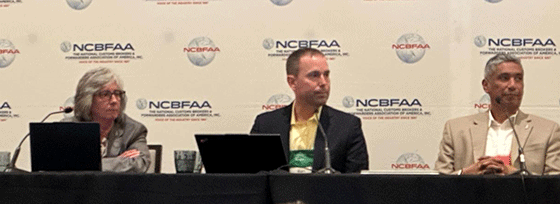 |
“I was honored,” Donna declared,” to moderate a panel on The Journey of an Air Export Shipment where we heard from Kurt Schenkemeyer, Director of Systems Operations & Compliance of Argents Express who represented the IAC and Vicente Herrera, Manager, Cargo Customs Compliance-American Airlines who represented the Screener and Carrier. (Jeff Koehl of GK9 was to represent the screener and CCSF but his flight was cancelled and he was unable to join us).
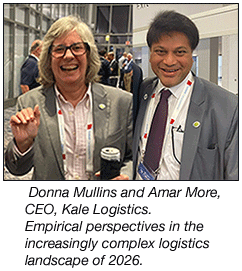 “Safety and security are the priority of international trade and logistics, and it was stressed that automation can and will help us achieve this goal and help to increase trade facilitation in a secure and compliant fashion,” Donna said. “Safety and security are the priority of international trade and logistics, and it was stressed that automation can and will help us achieve this goal and help to increase trade facilitation in a secure and compliant fashion,” Donna said.
Here we come to what Kale has in mind these days and to that point Donna did not miss a beat.
“Kale Information Solutions electronic data exchange in our ACS/PCS and other products can also help prevent cargo theft because a Trusted Trade Partner is required and the data, unlike a piece of paper, cannot be routed to unauthorized parties,” Donna concluded.
Now in its 53rd year, the NCBFAA Annual Conference brings together more than 600 of the international trade industry's top representatives from around the United States.
Headquartered in the Washington, D.C. metro area, the NCBFAA represents more than 1422+ member companies with 110,000 employees in international trade - the nation's leading freight forwarders, customs brokers, ocean transportation intermediaries (OTIs), NVOCCs and air cargo agents, serving more than 250,000 importers and exporters.
Simple fact is that NCBFAA members handle more than 97% of the entries for shipments imported into the United States.
Geoffrey Arend
|




 Vol. 25 No. 18


 100%
Green
100%
Green