 |
PayCargo recently published a press release that made us think. Are we witnessing the inception of an entire new concept in logistics, we wondered . . . ? Is PayCargo launching a new global initiative? Maybe. Let me explain, please.
Perhaps we can check the actual value of the term “global” first. This is an adjective that we use very often without thinking how far we are expanding our considerations by using it. The original meaning, according to the Oxford dictionary, is “having a spherical shape or form”, which dates back to 1637 as its first recorded instance. Then it took the significance of “relating to or encompassing the whole of anything or any group of things, categories, etc.” first recorded in 1835. Its mathematical use as “occurring or valid at every point of a space or every value of a variable” is first recorded in 1937, whilst in 1961 we started using it to describe something “of or relating to (the whole of) a planet [other than Earth]”. We come to the most interesting use, as far as we are concerned, in 1964: “relating to or affecting the whole of a program, text, etc.” which is used in computing and IT related activities.
The Oxford dictionary does not mention logistics, but I am almost sure that could hit the top if you search for the combination of both. AI replied perfunctorily to my question, as follows: “While there is no single, absolute count for how many times the term "global" is used within the logistics industry, it is one of the most frequently used, foundational terms in the field. It is a central keyword in describing logistics strategy, trade, supply chains, and market reach.”
 This is how PayCargo starts its own summary: “The trusted logistics payment platform, today outlined the next phase of its evolution, reflecting the increasingly central role payments play in global logistics and how PayCargo continues to support the industry’s operations. Originally built to streamline freight payments tied directly to cargo release, PayCargo has long helped logistics organizations reduce delays caused by manual, fragmented processes. The foundation still remains – but the challenges have become more complex. As supply chains become more global and interconnected, delays and extended dwell times are increasingly driven by fragmented financial processes that sit behind cargo movement.” This is how PayCargo starts its own summary: “The trusted logistics payment platform, today outlined the next phase of its evolution, reflecting the increasingly central role payments play in global logistics and how PayCargo continues to support the industry’s operations. Originally built to streamline freight payments tied directly to cargo release, PayCargo has long helped logistics organizations reduce delays caused by manual, fragmented processes. The foundation still remains – but the challenges have become more complex. As supply chains become more global and interconnected, delays and extended dwell times are increasingly driven by fragmented financial processes that sit behind cargo movement.”
In other words, PayCargo is identifying the persisting inefficiency in the flow of payments accompanying anything logistics as a global challenge and is ready to address it by finding another gear in their services: “PayCargo is evolving its platform to more closely connect financial and operational workflows through greater intelligence and automation, enabling logistics organizations to move cargo with greater speed, transparency, and control. Payments remain the foundation, while the platform advances to support more connected, execution-focused logistics operations – reflecting a simple reality of modern supply chains: smarter logistics starts with smarter payments.”
Remember the line ‘L'argent est le nerf de la guerre’? This is often cited as Napoleon’s statement, but it comes from a much earlier time, another space, Thucydides’s ancient Greece. Truth is . . . in this global world, wherever you come from, it all boils down to the money in the end.
You might think we are going nuts, but please bear with us one more minute.
Connecting money and logistics, you come to an almost bewildering conclusion. If you make smarter payments available globally you can address and resolve one of the biggest problems in global logistics: in the complexity of the global value chains working with any party available by making each and every party a trusted partner that you can work with. In other words, you are making the entire world a global, interconnected logistics platform. In so doing you are ‘relating to or encompassing the whole of logistics on the entire planet by relating to and affecting the entire logistics payments requirement’, if you want to give it an Oxford-dictionary-like definition . . .
 |
And this is precisely what PayCargo says: “As part of this evolution, PayCargo is expanding its intelligence and automation capabilities to help organizations identify bottlenecks, reduce manual intervention, and make faster, more informed decisions around cargo release and movement. Through PayCargo Intelligence, financial and operational events can be captured, verified, and better connected across workflows.” One could argue that this is not completely new, as we have seen many attempts to make logistics more efficient by using IT, and now AI. But one way or another we had always started from the “buy-ship-pay-model” and ploughed our way upstream as a run of salmon. Now the concept is quite the same, but it is looked at with a novel, upside-down approach. It might really work!
And we can hear this concept from Eduardo Del Riego, CEO of PayCargo himself: “Payments have always been at the center of how PayCargo supports cargo movement,” said Eduardo. “What’s changing is the scope and complexity of the challenges logistics organizations are trying to solve. Because of our global network and deep logistics expertise, we’re uniquely positioned to address those challenges and evolve the platform to support how logistics organizations operate today – and where it’s headed next.”
It is more than evident that this new global approach is a new step, which rests on the experience built in several years of data collection. “Today, more than 150,000 logistics businesses worldwide use PayCargo to securely move freight payments, manage invoices, and accelerate cargo release across Air, Land, Rail, and Ocean transportation. That scale reflects PayCargo’s role across global trade and complex logistics networks. With deep industry expertise and a broad global network, PayCargo has a unique vantage point into how financial activity affects cargo flow across regions and trade lanes.”
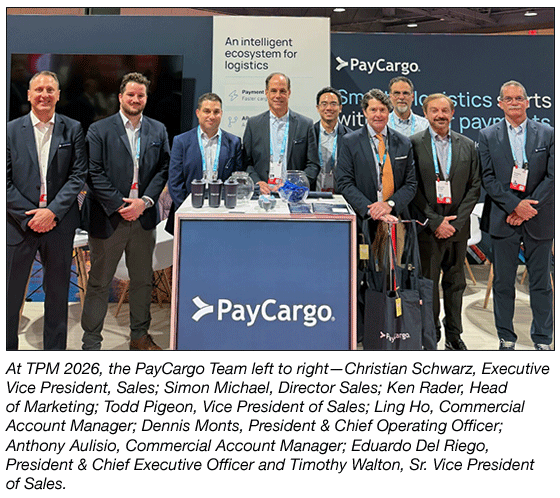 |
At this year’s TPM event in early March, PayCargo showcased the latest capabilities of the platform, addressing an industry concern: the timing gap between physical cargo movement and the financial processes that support it. When verified supply chain events generate trusted data and financial confirmation, the next step in the workflow can happen immediately. Dennis Monts, President and Chief Operating Officer, PayCargo Labs, spoke about “how the integration of payments and visibility transforms how operational events are captured, verified, and valued.”
“Instead of waiting for manual payment verification, cargo release and financial settlement can occur simultaneously. When those processes move in sync, the pause between “cargo is ready” and “cargo can move” begins to disappear.”
In commenting on the initiative, Del Riego said: “The goal is broader relationships with existing customers and to go global.”
I hope I am not trying to be more catholic than the Pope, but this language sound pretty clear to me. Let’s go global and embrace the world!
Marco L. Sorgetti
|



 Vol. 25 No. 12
 Vol. 25 No. 13


 100%
Green
100%
Green