

|
There is really no need to introduce Jan Krems to our readers, but for the record he is President of United Airlines Cargo. Jan has been our guest so many times we cannot even remember, yet there is always something new and interesting in listening to what he has to tell us. In this complex period, we had the privilege of talking to him informally and we are delighted to report the essence of the conversation in these pages.
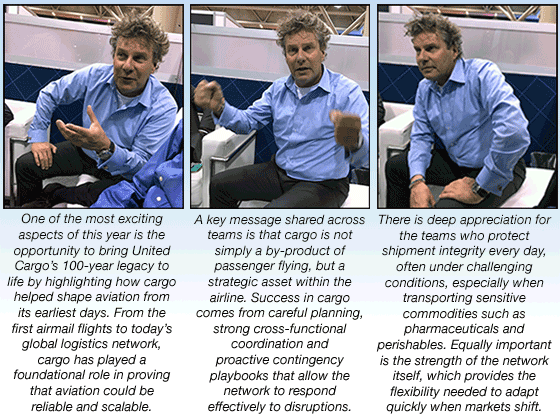
We were wondering how this confusing start of the year looked from United Cargo’s perspective and Jan told us that “one of the most exciting aspects of this year is the opportunity to bring United Cargo’s 100-year legacy to life by highlighting how cargo helped shape aviation from its earliest days. From the first airmail flights to today’s global logistics network, cargo has played a foundational role in proving that aviation could be reliable and scalable.”
“Looking ahead, the focus is also on strengthening network resilience through greater optionality, flight frequency, and smarter recovery planning so that shipments continue to move even when disruptions occur. At the same time, expanding digital booking access and shipment visibility tools is making it easier and faster for customers to do business with United Cargo across its global network.”
Everyone is getting ready for IATA’s WCS in Lima and Jan is obviously preparing: “At the upcoming IATA World Cargo Symposium in Lima, an important priority is highlighting how United Cargo’s network design protects critical shipments, particularly perishables moving through Latin America.” Jan told us. “Multiple U.S. gateways and high-frequency schedules help safeguard cold-chain integrity while reducing transit times and spoilage risk.”
We observed that the event also provides an opportunity to strengthen partnerships across the industry, which are essential to building resilient global supply chains, and Krems agreed completely: “Finally, it is a moment to demonstrate how passenger belly capacity, when properly optimized, can deliver both the scale and flexibility needed to support global trade.”
The conversation moved on; we were wondering what impressions Jan Krems has instilled and shared with team members at United Cargo. We are all in a people’s business and those who work with us need to be considered first when you plan your organization. Jan told us that “a key message shared across teams is that cargo is not simply a by-product of passenger flying, but a strategic asset within the airline. Success in cargo comes from careful planning, strong cross-functional coordination, and proactive contingency playbooks that allow the network to respond effectively to disruptions. Reliability and operational discipline are deeply embedded in United’s culture, rooted in the earliest days of transporting mail when aviation first proved its value. At the same time, adaptability has always been essential, allowing United Cargo to evolve alongside global trade and changing customer expectations for nearly a century.” It is always useful to hear somebody who has a 360° overview of the situation, be it historical, organizational or commercial. This is what we mean when we talk of ‘business culture’, and here it is abundant.
Looking at the entire United Cargo business culture: its people and customers, its influence, there are many reasons to be proud and reasons for being grateful. In this Jan Krems did not shy away, on the contrary he came forward with a set of good points. He said that “there is deep appreciation for the teams who protect shipment integrity every day, often under challenging conditions, especially when transporting sensitive commodities such as pharmaceuticals and perishables. Equally important is the strength of the network itself, which provides the flexibility needed to adapt quickly when markets shift or operational disruptions occur. United Cargo is also grateful for customers who trust the airline with high-value and time-critical shipments that directly impact businesses and communities. Above all, there is gratitude for a legacy defined by continuous adaptation and innovation rather than complacency.” These are words that command respect, even though they were probably not uttered with such intention. Their meaning is unmistakable though, and as such we have received them with respect as they deserved.
The next point in the discussion was expectations for the immediate future, what else?
In this summersaulting year of the Horse, Jan’s expectations took a more thoughtful approach, with “center on further strengthening United Cargo’s position as one of the world’s leading belly carriers by combining network scale with operational agility. The focus will remain on deepening customer trust by delivering consistent service, greater transparency, and faster recovery when disruptions occur. Continued investment in digital tools will further enhance booking speed, pricing access, and shipment visibility, making the customer experience more efficient and predictable. Sustainability will also remain a key priority, with progress driven by fleet modernization and increased participation in sustainable aviation fuel initiatives.”
 |
There is more than enough to keep you busy . . . Never a dull moment, one could observe, and in fact there is never a dull moment, in particular if you look at the different regions where the actions take place. This being said, “United Cargo’s strength lies in the scale and structure of its global network. In North America, a dense system of hubs and daily flight frequencies provides customers with exceptional routing flexibility and recovery options. In Latin America, strong perishables corridors are supported by temperature-controlled processes and multiple gateway options that help maintain cold-chain integrity. Across the transatlantic and transpacific markets, wide-body capacity supports the movement of high-value and time-sensitive goods across long distances. Globally, the network is designed with resilience in mind, relying on diversified routing and multiple gateways rather than single-lane dependency.” In other words, you are contemplating one single product concept that is locally fine-tuned according to the existing resources and the business requirements, but it works as one body of thought.
If our readers wonder what changes will be available at United in the course of the year and what will be different from the past, this is a curiosity that is easily satisfied by looking at what has recently come to fruition at United Cargo: “Over the past year, United Cargo has expanded its digital booking platform integrations, improving access and transparency for freight forwarders worldwide. The organization has also strengthened its resilience planning for winter operations and severe weather by activating contingency strategies earlier and leveraging predictive analytics. Cold-chain handling has been enhanced through tighter monitoring, standardized processes, and stronger compliance alignment across stations and partners. These improvements are complemented by continued investment in sustainability initiatives, including expanded participation in sustainable aviation fuel partnerships.”
So we are contemplating an organization that is evidently successful, that is considerate with its workforce and focused on its customers’ requirements, but one could say that this is not surprising, even though not always present elsewhere. But “a key factor behind United Cargo’s success has been the ability to leverage the scale of the passenger network as a strategic cargo advantage. By reinforcing optionality through multiple gateways, diversified routing, and frequent schedules, the network is better protected against disruption. Another important element has been strengthening cross-functional alignment so that sales, operations, and hub teams work together proactively rather than reactively. In parallel, digital integration has modernized customer engagement and operational execution, enabling faster decision-making and improved service reliability.”
In other words, the entire fleet moving across the globe is an asset for promoting United Cargo’s service levels, and we are not talking of a minor network here, so the asset is huge!
The conversation came then to a more personal, forward looking consideration. What are the tasks, the expectations and the results of those who plan an air cargo career today? Can United work as an example for the younger generation? Jan was very clear: “Anyone entering the air cargo industry should understand that reliability is everything, as customers design their supply chains around predictable performance. The field is complex and operationally detailed, requiring precision and disciplined execution even under pressure. It is also important to think in terms of networks rather than individual flights, because the strength of air cargo lies in connectivity and routing flexibility. Finally, embracing data, digital tools, and adaptability is essential, as technology and global trade patterns continue to transform the industry.” It is challenging, but fascinating and still a promising career in 2026, at a time when many others are questioning their roles.
In conclusion, looking at the air cargo industry and what can it do collectively to better itself and be more successful in the years to come Krems had no uncertainty: “Looking ahead, the industry should focus on building resilience into the system, not just efficiency. Diversified routing, stronger collaboration among partners, and proactive contingency planning will allow networks to absorb volatility rather than react to it. At the same time, the industry must commit to greater end-to-end transparency and sustainability. Deeper digital integration across the supply chain, combined with broader adoption of sustainable aviation fuel and operational efficiencies, will strengthen performance, build trust with customers, and ensure the long-term relevance of air cargo.”
There you go, we just had a conversation studying the business case of air cargo requirements, not just merely looking at steps and achievements of a cargo airline. That is more than we originally intended, hence we are very thankful to Jan Krems for his crystal clear explanations and contributions. |
We can only wish him and his team the best in their endeavours and long lasting achievements.
GDA/Marco Sorgetti
|




 Vol. 25 No. 10
 Vol. 25 No. 11


 FlyingTypers reserves the right to edit all submissions for length and content. All
photos and written material submitted to this publication become the property
of FlyingTypers Media.
FlyingTypers reserves the right to edit all submissions for length and content. All
photos and written material submitted to this publication become the property
of FlyingTypers Media. 100%
Green
100%
Green