|
With India’s air logistics ambitions accelerating, the timing could not be more strategic. Keshav Tanna—veteran freight forwarder, long-time policy influencer, former President of ACAAI and one of the strongest advocates of building a globally competitive Indian forwarding ecosystem—has now assumed charge as Secretary General of FIATA, the International Federation of Freight Forwarders Associations, based in Geneva, CH, the most influential global body representing over 40,000 logistics and forwarding companies across 150 nations.
For India, this is not merely representation. This is leverage. Tanna takes over FIATA as SG at a moment when global capacity disruption continues to destabilize cargo flows and reorder business models.
 |
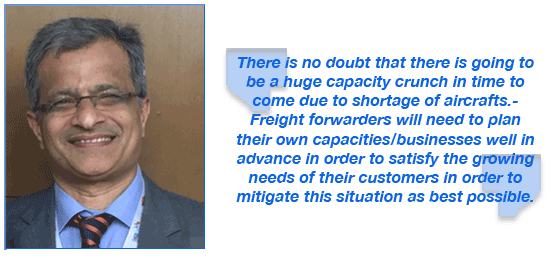
In his business capacity, Keshav warns very sharply that the industry is entering a next cycle shortage of aircraft capacity that will structurally distort networks. “There is no doubt that there is going to be a huge capacity crunch in time to come due to shortage of aircrafts,” he says. “The current fleets are getting old and new aircraft as ordered are facing delayed deliveries. Aircraft shortages have become a severe capacity constraint, limiting airlines’ ability to satisfy growing demand.” He estimates “the accumulated shortfall of aircraft from 2019 to 2025 is nearly 5000 aircraft,” and notes that deliveries “are lagging nearly 30% beyond their peak levels.” That means freight forwarders — especially SMEs — have to plan capacity long before the crunch hits the operational front. “Freight forwarders will need to plan their own capacities/businesses well in advance in order to satisfy the growing needs of their customers in order to mitigate this situation as best possible.”
Tanna’s forward agenda at FIATA is rooted in the one constituency he has consistently fought for in India: the small and medium forwarder. “FIATA’s goals are very clear in uniting the Freight Forwarding community at large, with the primary objective to best look after the business/commercial interests of the Small & Medium Forwarder, who requires hand holding in various aspects of the ever-changing logistics scenario around us.”
This is also where India stands to gain unprecedented access and influence. FIATA’s regional governance structure — he stresses — ensures that the organization does not become another transatlantic voice shaping rules for the rest. “Our unique regional structure at FIATA with its division of different regions into Region Asia Pacific, Region Americas, Region Africa and Middle East, and Region Europe, which have near equal representation, ensures that every region is adequately represented to address the local issues effectively.” India’s domestic freight sector — dominated by SMEs — aligns almost perfectly with this architecture.
 |
Tanna is also very clear that the role of forwarders is changing faster than governments and legacy regulators acknowledge. “The role of the freight forwarder is ever evolving but needless to say that we survive in ‘chaos.’ If we could overcome COVID and put our cargo where our passenger colleagues were, then any disruption that comes our way can be handled.”
In future, forwarders will work more and more as contractual carriers, especially in a multimodal world where air cargo, rail and ocean are converging into end-to-end. “By working closely with airlines and other stakeholders, we will tackle emerging challenges – whether in safety and security, capacity management or operational efficiency.”
Tanna highlights the centrality of digital standardization: “We have developed many standardized transport documents such as the FCR, the FCT, the FWR and the latest truly digital being the eFBL which serves as a truly digital multimodal transport document.”
On the talent front, FIATA is doubling down: “The FIATA Diploma in Freight Forwarding; the FIATA Higher Diploma in Supply Chain Management; the ICAO-FIATA Dangerous Goods by Air Programme . . . These programmes are delivered by FIATA Association Members . . . adapted to ensure the content remains relevant and responsive to the evolving challenges of the industry such as digitalization, sustainability, and the growing need for both technical and soft skills.”
Tanna’s ACAAI legacy remains his transformative work in a period where Indian forwarders moved from handling to becoming strategic logistics solution providers. He led structured engagement with airlines and terminals and pushed for an India that negotiates from strength — not from subordination.
What makes Tanna uniquely positioned in the industry is that infrastructure reform is not new territory for him. During his ACAAI years, he was one of the earliest and loudest champions pushing the Indian government to move from reactive cargo development to proactive planning. He repeatedly said India needed to “wake up the slumbering giant” of cargo infrastructure. He was a major voice behind the push for Air Freight Stations (AFS) — long before they were mainstream policy discussion — arguing that India’s logistics backbone needed decentralization and hinterland connectivity to be globally competitive.
“A pro-active, instead of a reactive, approach is needed by the government for air cargo growth,” he would often remind policymakers.
At that time, India had just started moving on infrastructure; Maplecroft UK had even called India “the world’s best growth-market bet” on the back of policy clarity and reduced red tape. The government announced AFSs in ten cities via Central Warehousing Corporation. But as Tanna noted then — and it remains true today — AFSs were demarcated in places like Chennai and Mumbai but “not commissioned yet.” This long battle for implementation, backed by ACAAI, was part of the foundation of the forwarder-led future he believes in.
 |
India can expect three immediate dividends from his tenure: global standard alignment, SME empowerment, and Indian voice inclusion in future ruleset formation around digital documents, multimodal rights and contractual carrier frameworks.
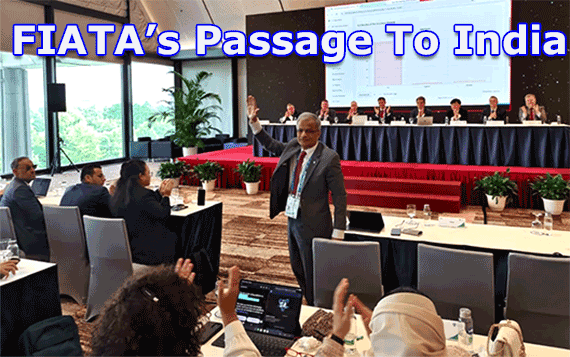
This is not the first time India has this degree of strategic positioning inside the world body, but the country had not detained such a high level position in the Presidency for several years. Eight years after the FIATA WC took place in Delhi in 2018, Tanna now brings FIATA back to India with his soft spoken, powerful discourse and brings the bright, shining colors of India back at the heart of FIATA.
Tirthankar Ghosh/Marco Sorgetti
|





 Vol. 25 No. 1



 FlyingTypers reserves the right to edit all submissions for length and content. All
photos and written material submitted to this publication become the property
of FlyingTypers Media.
FlyingTypers reserves the right to edit all submissions for length and content. All
photos and written material submitted to this publication become the property
of FlyingTypers Media. 100%
Green
100%
Green