Austrian
Airlines For Sale
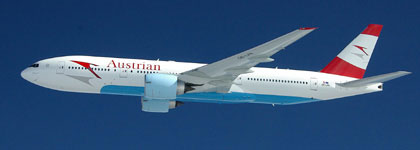
 Austrian
carrier AUA does not exclude the possibility to sell the majority
of the stakes to an investor or strategic airline partner. Austrian
carrier AUA does not exclude the possibility to sell the majority
of the stakes to an investor or strategic airline partner.
"The conditions for the airline
industry have dramatically worsened lately," admitted AUA’s
CEO Alfred Oetsch speaking to Air Cargo News FlyingTypers.
“If there is little chance for
sustainable profitability, I’m not sure if AUA can survive
on its own by staying independent," he warned.
“In that case I favor a clear
decision by selling the majority of the AUA shares."
Since the Vienna-based airline hedges
kerosene to only a small degree it is hit extremely hard by rising
fuel prices. Further, low cost carriers are pushing aggressively
into AUA’s core European market putting increasing pressure
on yields.
Consequently the carrier reported
massive losses in Q1.
Austria’s minister of finance,
Wilhelm Molterer, basically backs Oetsch’s turn in strategy.
He announced a plan for a strategic
concept that will be ready by summer to serve as platform for a
partial privatization of the state-dominated carrier.
Harsh criticism however, came from
Austrian chancellor Alfred Gusenbauer who rejected any privatization
plans. "My government assumes that AUA will remain Austrian,"
he said boldly.
Other voices warned that in case a
major carrier would swallow AUA, especially neighboring Deutsche
Lufthansa, this might have a negative impact on Vienna Airport.
In that case traffic could be shifted
from Vienna to Munich, Frankfurt or Zurich, the three major European
hubs LH and partner Swiss are concentrating their operations on.
Lufthansa spokesperson Claudia Lange
rejected any speculations whether her airline might buy into financial
ailing AUA.
"They first have to straighten
out themselves which road they want to pursue," Lange said.
"Principally we support the consolidation
of the European airline landscape but opt strictly for friendly
take-overs."
“In that case LH is a “safe
harbor” for carriers in search of a strategic partner,”
Frau Lange assured.
Heiner Siegmund
|
Tempelhof
Mother Of All Airports
 There is this children’s
book I used to read to my kids called In The Night Kitchen
by Maurice Sendak that has this little boy singing a song that repeats
the words over and over, “I am the milk and the milk is me.”
There is this children’s
book I used to read to my kids called In The Night Kitchen
by Maurice Sendak that has this little boy singing a song that repeats
the words over and over, “I am the milk and the milk is me.”
For some reason those lines have been
knocking around inside my head ever since I heard that a Grand Dame
of close-in city aerial gateways, Tempelhof Airport in Berlin is being
closed forever at the end of 2008.
This
year is the 60th anniversary of the Berlin Airlift that supplied an
entire city from the air proving the power of air cargo through the
long winter of 1948.
But in 2008,
the politicians including the current Mayor of Berlin are set on closing
the airport despite a campaign and a majority opinion to save it.
The Berlin Airlift 60th Anniversary
to be celebrated next week will not take place at THF that is still
open for business and landing airplanes, but rather at Schönefeld
Airport, in the former East Berlin as part of The Berlin Air Show
May 27-June 1.
Tempelhof that was
built on some old parade grounds is where once upon a time Orville
Wright flew his airplanes.
During
the 1930’s the Tempelhof Terminal was the largest building in
Europe.
But even more than that,
Tempelhof is a gloriously beautiful bit of airport architecture, simply
exquisite in every detail.
The place
is about moving people, and also travelers who have a moment to stand
back and look around are moved just as well.
Little
wonder that this field, one of the first commercial airports in Germany
was labeled for all time by noted architect Sir Norman Foster, who
after walking through the Terminal called Tempelhof the "mother
of all airports".
On June 24,
1948, DC-3s, DC4s and other military aircraft began delivering millions
of tons of food, coal and other supplies to West Berliners with aircraft
landing around the clock every 90 seconds.
Along
with the hard stuff to keep the city alive, the fliers also improvised
handkerchief parachutes of raisins and chocolate.
The
aircraft were called Raisin bombers.
There
doesn’t seem to be much of a plan as to what will happen to
THF, once closed.
Most think that
the big central terminal will stay and feature some kind of adaptive
reuse while the runways will be used for public park space.
It’s
kind of strange that today when around the world in-town airports
like THF, LGA and others are utilized until the neighbors complain.
But complaints are not what happened
here.
In fact, according to reports
around Tempelhof in neighborhoods like Neu Köln where the life
style is easy and the jelly doughnuts the best ever tasted, people
are in support of Tempelhof staying open.
The
architectural writer Gerhard Matzig, in Süddeutsche Zeitung,
put it this way: "There are residents of Tempelhof who can understandably
imagine a life without aircraft noise and danger, but the much more
interesting phenomenon is the string: aircraft - noise - barbed wire
- coziness.
“Lending THF another
function, as a museum, or putting it to another use, would not really
spare it.
“In any other form
Tempelhof would lose it’s strength and magic.”
Tempelhof
Airport is a beautiful place, right at home with the city Berlin is
today.
It’s a field of dreams
of romance, history and function.
Along
with Tegel and whatever ends up being BBI tomorrow, Berlin is better
for having Tempelhof Airport.
Berlin is Tempelhof and Tempelhof is Berlin.
There
are still some moments left in a song that began in 1923.
I
am going to try and attend the Berlin Airlift Days next week.
But if I get there I am going to stay
near THF and find some time to just sit in that beautiful old airport
and think about these things.
Geoffrey |
Air
India Outlines Future
 The
competition in the air cargo sphere in India is becoming intense
and Air India does not wish to be left behind in the race. The
competition in the air cargo sphere in India is becoming intense
and Air India does not wish to be left behind in the race.
After many fits and starts—the
merged entity of Air India and Indian—is yet to settle down.
But that has not deterred Anita
Khurana, Director Commercial & SBU Head Cargo, National Aviation
Company of India Ltd., to lessen her speed.
Ms. Khurana had been spearheading
the erstwhile Indian's moves in the air cargo sector.
She was instrumental in bringing
in automation for the carrier's cargo and till today, Indian is
the only state-owned cargo carrier that provides track and trace
facilities.
Shippers booking on Air India do
not have the facility.
Now, with the Air India and Indian
merger, she would like to enhance operations and expand the reach
of Air India cargo.
The capacity Air India is offering
to shippers now is 1,300 tons/day on the network.
As she put it:
 "The
annual international freight movement into and out of India is
over 1.0 million tons and has been growing at 13.7 percent during
the period 2003-07 and 2006-07." "The
annual international freight movement into and out of India is
over 1.0 million tons and has been growing at 13.7 percent during
the period 2003-07 and 2006-07."
According to the Planning Commission,
this will grow at a rate of 11.5 percent from 2007-08 to 2011-12.
"AI's ranking has jumped from
ninth position in September '07 to No.1 in March '08 for exports
ex-Delhi."
Under the circumstances, Air India
will require much from its present six freighters (two Airbus
310s and four Boeing 737s).
Anita Khurana said AI plans for
2008-09 include offering more freighter capacity at competitive
rates.
In addition, she is pushing ahead
for more technology and that would include not only booking and
tracking on the web but also EDI connectivity and implementation
of bar-coding and a pallet tracking system.
All these moves would fall into
place when Air India starts hub operations at Nagpur for both
domestic and international operations beginning this September
in the first phase.
Ms. Khurana, points out: "Nagpur
being centrally located will provide excellent scope for the further
movement of goods to every nook and corner of the country either
by air or by any other logistics mode (road & rail)."
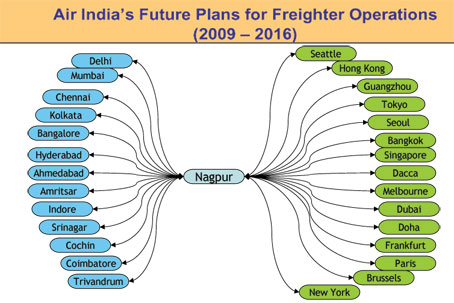
If all goes according to plan, Nagpur
between 2009 and 2016 will be the link for Air India between 13
domestic cargo destinations and 15 stations abroad from the present
Mumbai/Bangalore/Chennai to Dammam and Frankfurt.
Tirthankar Ghosh
|
Women In Cargo Hall Of
Fame |
| 
Olga
Pleshakova
|
|
 An
Air Cargo News/FlyingTypers Original An
Air Cargo News/FlyingTypers Original
Our exclusive series
“Women
In Air Cargo” asks our readers to send some words and
a picture about somebody that you know who is female and has made
a difference in air cargo.
This effort is not limited to just success or failure,
it is meant to raise awareness about the legions of unique women
who in most cases are unsung heroines in the air cargo industry.
So write and we will share your story with our readers
around the world.
|
Kelleher
Luv Fest
 Transport
Workers Union (TWU) Locals 555 and 556 representing Southwest Airlines’
7,000 ground workers and 9,000 flight attendants turned Wednesday
May 21 Southwest shareholders meeting into a “LUV fest”
to honor retiring Chairman of the Board Herb Kelleher. Transport
Workers Union (TWU) Locals 555 and 556 representing Southwest Airlines’
7,000 ground workers and 9,000 flight attendants turned Wednesday
May 21 Southwest shareholders meeting into a “LUV fest”
to honor retiring Chairman of the Board Herb Kelleher.
TWU members distributed recipe cards
with Herb’s ingredients for fostering positive labor/management
relations and Herb’s simple recipe for success.
“Herb has built a great airline
by always putting employees and customers first and TWU members
are thankful for his many years of leadership.
“Our attendance at the shareholder’s
meeting is our way of displaying our respect for Herb and our members’
commitment to the continued success of our airline,” said
TWU Local 556 President and flight attendant Thom McDaniel.
TWU Local 555 President Charles Cerf
agreed.
“It may seem unusual for a labor
union in contract negotiations to honor a company’s senior
executive,” he said, “but Herb is a remarkable leader
who has always understood the importance of doing the right thing
for employees and we are truly grateful for that.”
TWU Locals 555 and 556 are affiliates
of the Transport Workers Union of America (TWU) and the AFL-CIO.
To say this kind of thing in the age
of the super technocrat CEO is rare, is putting it mildly.
In fact, many airline and company
chieftains are hung in effigy, is closer to the truth especially
if they hang around the business as long as old Herb.
But the guy is right down on the ground
four square with everyone so we too join that happy throng who want
to feel good with good reason about the man.
Our favorite Herb story happened while
attending Bill Boesch’s retirement party as President of American
Airlines Cargo in Dallas, Texas. Herb showed up and began an animated
conversation with AA CEO Bob Crandall in the back of a room with
about 300 people in it.
During those days, ole Herb chain
smoked and drank glasses about three fingers full of Wild Turkey.
So while up on the stage Dal Sherman
and Mark Najarian were dancing and Jan Meurer of KLM was waving
a fist full of tulips goodbye to Bill, old Herb and his raspy smoke
and booze tenor whisper could be heard in the furthest parts of
the room.
Finally somebody said :
“Hey Herb, want to say a few
words about Boesch?
Kelleher without missing a beat turned
from Crandall and said in a now booming voice:
“Sure, I’ll say a few
words about that scum bag!”
The place erupted and that party is
remembered as one of the classic goodbyes ever.
So long Herb, in your tuxedo and cowboy
boots formal wear.
You are truly one of a kind.
Thanks for the ride!
Geoffrey |
|