Tragedy In China
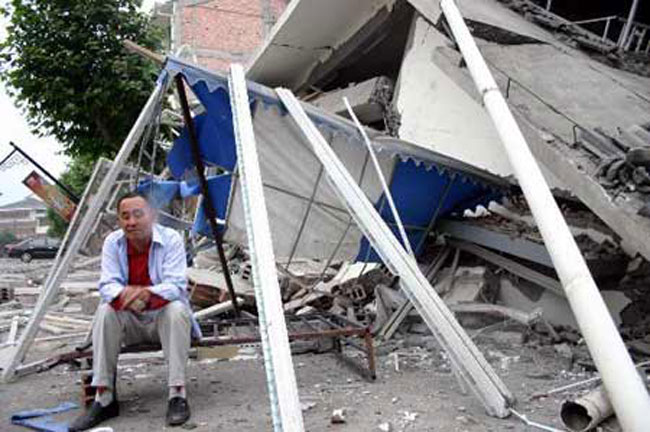
(As news of the tragic earthquake centered in Chengdu
Sichuan continues to be reported worldwide, our correspondent, David reports
back from Shanghai that a year of high expectations has left many people
in China wondering when things will go right).
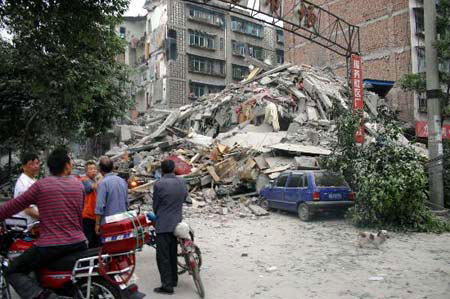 (Exclusive
Shanghai)—So far, the year 2008 has been full of
surprises and no small amount of concern and empathy for all the Chinese. (Exclusive
Shanghai)—So far, the year 2008 has been full of
surprises and no small amount of concern and empathy for all the Chinese.
It started with a happy vision of China
hosting the Summer Olympic Games for the first time.
But things have not happened as we expected.
I imagine many Chinese now share the same
feelings I have – that the year 2008 has sadly turned out to be
painful and difficult.
For a long time, the railways were thought
to be the safest mode of transportation in China. Many could not even
remember the last time a railway accident occurred.
But on April 28, a breach of duty resulted
in the loss of 72 lives with hundreds of passengers left injured.
Many lost their belief in railway security.
The EV71 virus, which has quickly infected
thousands of children across several provinces of the country, recalls
to many of us the memory of the SARS epidemic suffered in 2003.
The SARS tragedy began at this same time
of year.
For years the government has repeatedly
and loudly expressed concern for the economy overheating.
Now, for the first time, the government
says we should prepare for possible economic slowdown.
In addition to everything else, the price
of food, housing and other services is skyrocketing.
The Chinese are slowly getting a different
feeling about this year. It is a feeling that is counterintuitive to the
way we once believed the year should progress.
The number “8” has a pronunciation
like the Chinese character “fa”, which means, “make
good money and enjoy good luck.” Now with only 88 days left to the
opening of the Beijing Olympics (88 days, which should be “doubly
lucky”), comes the worst Chinese tragedy in thirty years.
On May 12, an earthquake with a magnitude
as high as 7.8M on the Richter scale erupted in Wenchuan County in the
Sichuan Province of China.
Although China is large, people in Beijing
over 1,500 km away still felt the shake.
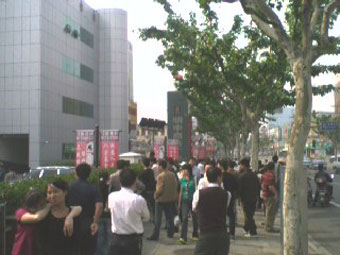 In
both Beijing and Shanghai (pictured left) there were many office buildings
(including the one I work in) that were evacuated after the one-minute
shake. In
both Beijing and Shanghai (pictured left) there were many office buildings
(including the one I work in) that were evacuated after the one-minute
shake.
Those who live a great distance from Wenchuan
County might have, like me, only been a bit frightened by the tremor.
I can only imagine how those nearer the earthquake epicenter have fared,
those that have lost everything and those that have lost lives.
According to reports from Xinhua Net, all
highways into Wenchuan were damaged, resulting in delayed arrival of rescue
troops and lack of detailed information about the situation of the city.
In the neighboring cities in Beichuan County
80% of the buildings collapsed, and in the city of Shifang two chemical
plants collapsed, leading to the leakage of some 80 tons of liquid ammonia
and hundreds of people buried in the wreckage.
In the city of Dujiangyan a whole school
collapsed, burying 900 students, with 50 reported dead.
The latest news released on May 13 says
that the earthquake has caused nearly 10,000 deaths; however, that number
might increase significantly as rescue workers go to work in the center
of the earthquake area, Wenchuan County.
China’s President Hu Jintao has said
that the disaster response would be rapid. Just one hour after the earthquake,
Premier Wen Jiabao flew to the earthquake area to direct the rescue work.
I have no doubt of the efficiency of the
Chinese government to undertake the rescue work, and I also believe that
people in safe areas of China and outside of China are willing and ready
to give their hands.
I only wish for the second half of 2008
to be a better time for the Chinese people, a time full of peace and happiness.
We extend all our prayers.
David. Edited by Flossie Arend.
|