|
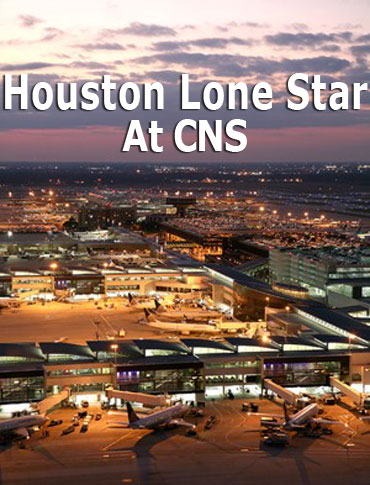  Genaro
Peña, Director of Marketing for Houston Intercontinental Airport
in the USA State of Texas dubbed “Lone Star,” is sitting in
the “bull pen,” a large, high ceiling reception area that
serves as a lounge and bar area at the PGA Hotel in Palm Beach where the
2008 CNS Partnership Conference is being held. Genaro
Peña, Director of Marketing for Houston Intercontinental Airport
in the USA State of Texas dubbed “Lone Star,” is sitting in
the “bull pen,” a large, high ceiling reception area that
serves as a lounge and bar area at the PGA Hotel in Palm Beach where the
2008 CNS Partnership Conference is being held.
The place is all overstuffed couches and
chairs and niche spaces and out of the way places that open to a front
porch overlooking the golf courses and swimming pool.
This is the place where the deals get done,
or at least created, and by 08:30 each day as this CNS Partnership continues
no less than a dozen individual groups of executives are meeting in twos
threes and fours all over the place.
The PGA is quite attractive with fairways
that have been manicured to the texture of an expensive living room carpet,
but the pace inside the bullpen, while laid back and quite genteel, belies
the calm with an ever-increasing frenetic even radioactive pace as the
day wears on.
Mr. Peña, who likes to describe what
is happening at IAH right now as “the perfect storm” as carriers
of every size ramp up service to the gateway, has been asked by CNS to
add his voice to a panel discussion about security although he is not
quite sure why.
“I am concerned that ever escalating
costs will create even more downward pressure on airport operators during
a time when everyone is trying to balance doing what is needed and right
against pressures to increase margins,” he says letting the thought
drift off for a moment.
Houston Intercontinental Airport has moved
itself into some kind of upper star status amongst all USA airports during
a time when candidates like JFK and MIA and others are fading.
Genaro Peña however knows that the
run up to getting the attention of Emirates and Cathay Pacific, Korean
Air, EVA, China Airlines and some players to be named later actually is
the result of some best-laid plans to see this prairie gateway take its
rightful place amongst the greatest airports in the world.
Genaro Peña is an understated guy
of specific goals who radiates class and distinction.
No matter what the situation, he is ever
deferential, pleasant and decent.
If it is raining elsewhere it’s also
just a short time away from a sunny day is the feeling you get when he
explains what draws carriers to the bright star in the Lone Star State.
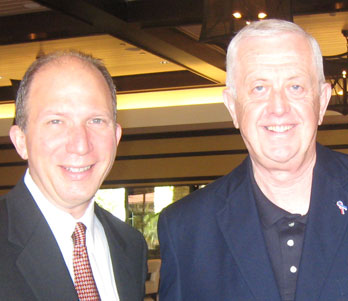
Genaro Peña pictured here at CNS
with Air Cargo News FlyingTypers Publisher Geoffrey Arend.
Mr. Peña describes IAH his “Perfect
Storm,” but unlike the movie of that name, the storm over Houston
is an accelerated run up of new airline services unmatched by any other
gateway in America right now and few others in history.
It seems that the world’s airlines
have discovered this place all at once.
“In the first place it is certainly
a major plus to be home base and major hub for Continental Airlines, one
of the most respected carriers in the world right now.
“Barely two months after launching
new services into IAH, Emirates Airlines added four additional weekly
flights with the carrier currently now offering daily nonstop service
to Dubai.
Emirates is handling approximately 16 tons
of air cargo out of Houston and bringing in roughly 10 tons, on each flight.
“During 2007 Houston Airport System
(HAS) moved 52 million passengers and over 387,000 metric tons of air
cargo.
“But as 2008 took off HAS kept the
pace up with even more increases as total freight tonnage grew by more
than 6.3 percent, year-over-year with international passenger traffic
up as well by 5.1 percent during January.”
The Houston Airport System (HAS) is (William
H. Hobby Airport, Ellington Field and George Bush International Airport.
“IAH is one of the few airports in
the nation primed for significant growth.
“Our 10,000 plus acre complex means
we have room to grow.
“We have been anticipating the needs
of our growing cargo and passenger base and that led to construction of
a fifth runway,” he said.
“We have been very fortunate in benefiting
from such positive traffic increases over the years, but we can’t
deny that a large part of our growth has been due, in part to the central
location of our city.”
“The fact that our neighbors to the
north and south are just a direct or nonstop flight away makes Houston
a destination not to be ignored.
“Today several dozen air carriers
offer access to more than 115 domestic and 73 international destinations
from Bush and Hobby airports,” Mr. Peña confirms.
“Many air carriers consider Houston
as primary gateway into the United States and the rest of the world.
“IAH, for example, offers the highest
number of weekly flights and serves the most Mexican destinations than
any other airport in the United States.
“What we are finding now is that many
Asian and Latin American businesses are looking for better ways to converge
their markets,” Mr. Peña explains.
“Literally, since China Airlines and
Korean Air Cargo inaugurated their services to Houston we have been getting
a lot more inquiries about new routes.”
Singapore Airlines arrived this past March
connecting Houston to Moscow, Russia and Singapore with four weekly flights.
Beginning on Tuesday, September 2, 2008,
Cathay Pacific Airways will launch three weekly, all-cargo flights to
Hong Kong from Houston.
The new service will mark the first scheduled
all cargo flights to Hong Kong from Houston and will become the fourth
scheduled Asian, all cargo connection from IAH.
Qatar Airways will begin operating three
weekly nonstop flights between IAH and DOH starting on Monday, November
10, 2008 – with plans for daily service in December of 2008.
But Mr. Peña admits that there are
some challenges as well.
“We have a 60,000 square foot facility
that is just ideal for operating a perishables center and we have been
searching for the right operator,” he says.
“We know that our gateway is ready
as a viable addition for the perishables trade to and from Mexico as well
as Central and parts of Latin America.”
Mr. Peña notes that his Houston odyssey
has been some 14 years in the development and making so that the recent
addition of new carriers can be expected to be followed with other exciting
and otherwise well thought out and planned ground-breaking developments
as well.
Geoffrey
An
Air Cargo Pro At CNS
  Once
upon a time Gulf Air of Bahrain was thought of as the “SAS
of the Middle East.” Once
upon a time Gulf Air of Bahrain was thought of as the “SAS
of the Middle East.”
Today though the other airlines of
that old partnership have flown off on their own, all things considered,
SAS ain’t what it used to be either if you get the drift.
But through it all has been Farouk
Salehjee, the Gulf Air Cargo guy in USA who is a solid down on the
ground as you might wish any airline to be up in the sky.
We caught up with this old line air
cargo pro at CNS.
“Amidst changes, we are still
a good resource ex London to and from the Middle East for must ride
air cargo and mail.”
On July 1, 2008 Gulf Air adds Hyderabad
from Bahrain to take advantage of two-way connectivity to many major
markets within the region. The route will be operated by using an
Airbus A320-200 aircraft, offering two-class service, business and
economy.
Hyderabad service will become the
eighth online destination for Gulf Air in India and it will increase
total India frequencies to 68 weekly.
In addition to the daily Hyderabad
start up, Gulf Air operates to Mumbai, Delhi, Trivandrum, Madras,
Bangalore, Cochin and Calcutta.
Gulf Air, the flag carrier of the
Kingdom of Bahrain, continues to pride itself as the airline with
the biggest network in the Middle East offering as many as 588 flights
every week in the Middle East with more non-stop flights than any
other airline.
“This is a great advantage to
the trade and industry, which has wider choice of flights to transport
their cargo across the Middle East and beyond to/from Europe, the
Indian Subcontinent and the Far East,” Farouk says.
“With excellent onward connections
and minimum connecting time between flights, customers can rest
assured that their cargo will reach at the shortest possible time.”
“As example, a container arriving
in Bahrain from London, for instance, can be on its way to Abu Dhabi,
Cairo, Jeddah, Kuwait or Dubai within an hour.
“Also we have made the move
into user-friendly, state–of-the-art, online tracking that
enables customers to monitor the progress of shipments at every
step of their journey from origin to destination.”
Gulf Air may be able to say that its
57 years experience in flying cargo throughout the Middle East region
and across the world is more than several of its regional competitors
combined.
But for some 30 plus of those years
it’s people, down on the ground who grind it out, make the
sales calls and sometimes stay up all night to insure that all goes
well, people like Farouk Salehjee that have made the going great.
Contact: farouksalehjee@aol.com
Geoffrey
|
leisure
Cargo Expands Markets

Now that Air Berlin has taken
over German carrier LTU and with the acquisition, fast-rising leisure
cargo based in Düsseldorf, Germany, China beckons, as AB service
to a giant new market commencing June 2 into Beijing and Shanghai will
dramatically impact the virtual air cargo carrier’s 2008 activity.
In China, responsibility for marketing and
sales lies with leisure cargo Asia.
Ground handling agreements have been signed
with BGS in Beijing and PACTL in Shanghai.
Officials from the companies are pictured
above after signing the handling agreement last month.
leisure cargo says that it will closely
supervise all transfers and continue building upon its close cooperation
with Hainan, one of leisure’s prime partner carriers in China.
Competition is tough, of course but leisure
aims to serve a growing China cargo business employing a niche market
strategy that serves small to medium sized, high-yield consignments while
offering total service and reliability to shippers.
With the excellently functioning connectivity
inside the Air Berlin Group and the established flight, as well as road
feeder services and cooperation among the members of leisure cargo, good
things are expected all around.
 |
Another example of continued cargo service
expansion is seen in the Americas as leisure cargo has created new airfreight
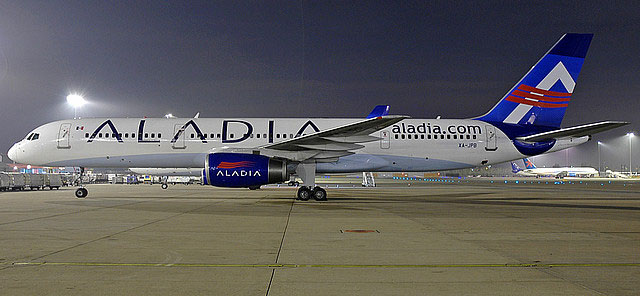
opportunities in Mexico. Aladia Airline of Monterrey, a start-up carrier
in the low cost, tourist-based segment has joined the group recently trusting
its total cargo management to leisure cargo.

Aladia CEO Andres Engels, right, with Erik Fraenkel,
leisure cargo director Latin America in Monterrey, Mexico.
Mexican GSA “Caribe Cargo”
in cooperation with OMA Carga, a branch of Grupo Aeroportuario del Centro
Norte, S.A.B. established export, and import services connecting the cities
served by Aladia with Cancun and the leisure cargo network serving more
than 200 destinations worldwide.
OMA is managing 13 airports in northern
and central Mexico combining the new airfreight routes with an existing
road feeder service.
The 19th carrier under the umbrella of leisure
cargo, Aladia is presently operating three B757s offering between three
and five tons of belly cargo capacity per flight.
“We have added interconnectivity in
the northern states of Mexico to the benefit of shippers and consignees
involved in global foreign trade and their cargo agents.
“The results are encouraging because
the payload utilization is close to 100%,” confirms Eric Ginebra,
President of Caribe Cargo.
For Aladia, this new cargo product connection
with leisure cargo offers a win-win situation as the additional revenues
from the carriage of freight on holiday flights are welcomed by the young
airline cutting its teeth in the market.
Aladia offers domestic connections to and
from Cancun, Mexico City, Monterrey and Guadalajara.
Help
For Myanmar
 Cyclone
Nargis that slammed into Myanmar devastated the country's Irrawady,
Yangon and Bago districts. Cyclone
Nargis that slammed into Myanmar devastated the country's Irrawady,
Yangon and Bago districts.
Estimates indicate that more than
a million people may be affected with some reports saying 100,000
may have perished.
UNICEF says the immediate need is
for basic necessities such as shelter materials and non-food items
(basic familial necessities) including mosquito nets, safe water
and sanitation facilities, and essential medicine.
UNICEF said that despite reports
it is working on the ground delivering relief and in fact has
had a permanent presence in Myanmar since 1950, and emergency
response efforts began immediately, drawing on pre-positioned
emergency medical supplies.
Some 130 UNICEF technical and operations
staff are on the ground in areas affected by Cyclone Nargis, identifying
the greatest threats to children and women and delivering lifesaving
supplies. More staff and supplies are on the way.
Please lend your support.
To donate to UNICEF's Cyclone Nargis disaster relief efforts,
please visit www.unicefusa.org/myanmar
|
|