Vol. 7  No. 84                                         WE COVER THE WORLD                                                                   Monday August 4, 2008

Emirates A380 Outshines JFK

     Emirates Flight 3801, an Airbus 380 with 489 passengers aboard arrived at John F. Kennedy International Airport August 1 setting an important milestone in aviation history as the first scheduled A380 serving New York, the world’s greatest city.
     For the record the flight from Dubai, landed just before 5 p.m.
     The New York Times reported “a last-minute shift in wind caused air traffic control to change the landing path to a much shorter runway (which made the plane very low to the ground when it landed, barely clearing the trees).
     “It was the aviation equivalent of the arrival of the Queen Mary 2,” NYT gushed.
     The New York Daily News added:
     “The plane's pilot, Capt. Shaban Abas, said flying the behemoth “was thrilling."FT08
     "She does very good landings," Abas said.
     Consensus amongst the passengers was that flying inside the big bird softens a long journey considerably.
     “It doesn’t feel like 13 and a half hours,” was the most oft repeated reaction amongst the passengers who had high praise for the total onboard experience with extra words and endearments for the crew.
     “They were just great, and we cannot wait to fly on this airline again,” one couple said.
     New York has hosted many commercial aviation first flights to and from both domestic and world destinations.
     In fact, prior to 1920 more than two-thirds of all aviation activity including first flights and aircraft manufacturing in the USA took place from New York City to the tip of Long Island.
     From the days of the flying boats at LaGuardia when Pan American World Airways was alive, and from 1948, when 80% of all USA international air travel was based here at IDL (now JFK), Pan Am aircraft such as B707 and B747 and international flag-carrying airliners from around the globe have entered service here first, and set one aviation record after another.
     But this A380 flight was something else and in many instances Emirates business as usual.
     From arrival at curbside to delivery into A380 and their other aircraft, Emirates service execution is just superb.
     At JFK, out at the end of a finger of Terminal Four, Emirates has installed an absolutely stunning business and first class lounge that is well stocked, supple and beautiful in every sense.
     Windows overlook a brand new gate that Emirates paid to construct so that business and first class passengers can keep the good feeling going and board the aircraft directly from the lounge.
     However on August 1st, there was amazement all around as reporters and invited guests and crowds of the curious gawked at the shiny, new giant airplane.
     Interestingly, like Dubai itself that once upon a time was thought of as an oasis, this small area of JFK airport is an enclave; an Emirates-driven throwback in the mass air travel age to the way it used to be, and maybe never was.
     Elsewhere at the airport despite a valiant effort by some air carriers and companies like Schiphol USA that operates Terminal Four, JFK to millions of travelers and people who do business here, is a mess.
     A concrete jungle of parking garages practically obliterates the sky while narrow twisting and over crowded airport roads lead to more impossible traffic for anyone trying to get to New York City.
     A billion dollar rail system to nowhere isn’t much help either, dumping passengers bag and baggage in the middle of a Queens, New York neighborhood where they can schlep to yet another train to get into Manhattan. The sad truth is that in 2008, as JFK celebrates its 60th year in business, the place no longer is even close to making the cut as a first rate international air gateway operation.
     JFK is a garbage truck with occasional flashes of chrome.
     “A beautiful airplane at a second rate airport,” is how one observer described the scene.
     A couple of years ago the then Mayor Rudolph Giuliani wanted to wrest control of the New York airports (LGA & JFK) away from The Port Authority of New York & New Jersey, saying that the city could do a better job of operating them.
     Maybe if “Hizzoner” runs for Governor of New York State in a couple of years, he might revive that idea at a level that can exert the pressure needed for real change, is the thought.
     But this day was to marvel at a great new airplane.
     Once inside, the A380 super jumbo is an envelope of serene civility, a super liner of the air in every sense where even the coach seats feel like business class.
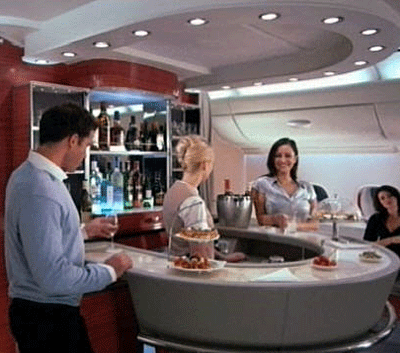
     In addition to those much-reported first class showers (we wondered why there are no showers in coach where the real people are?), Emirates gets our vote and ultra high marks for bringing back the airplane bar.
     The idea that lounge lizards may once again be reborn at 37,000 feet is just too sweet to believe.
     Now if I can only squeeze into my 1960’s continental styled suit.
Geoffrey


Rational Rates
Beyond Reason

     With all the talk swirling about air cargo about Flying Typers—“Fuel Surcharge Overhaul” stories of the last two weeks initiated by that KL/AF press conference in Paris earlier this month, it might be helpful to revisit how the “current formula for calculating fuel surcharges” was determined.
     In any case since the 1990’s IATA has not enjoyed antitrust immunity in the U.S. regarding pricing matters and this certainly was already the case in 1996.
     Just as freight rates are set by the market, and after deregulation, are not subject to government filing or approval, so evidently why can’t the fuel surcharge be similarly modified.
     I still struggle to understand some of the evidence cited, as reform is called for.
     “Inflexible currency exchange” is one term often used.
     We also hear that “airfreight invoices for customers in Europe contain 90% fuel surcharges and 10% rates” and “surcharge amounts moved 19 times during the last 30 months.”
     When fuel is at $140 a barrel, its price is traded on the global market and fluctuates frequently.
     This is the reality the airlines wake up to every day. The airlines are not fuel hedging companies nor is the customer willing to take on the daily risk of hedging fuel prices, so the airlines has no alternative except to continually adjust their surcharge.
     The subject is transparent and well known to all participants in the transportation chain, governments and the public at large. The problem is not the airlines but the government’s inability to put in fuel pricing controls.
     Another charge is:
     “Customers have no faith in a system this illogical and erratic.”

ARTICLES RELATED TO THIS OPINION
KL/AF Surcharge Reaction
Letters—In Your Own Write
Surcharges Unlock Deeper Issues
More Letters On Surcharge Issue
Will KL/AF Charge Revamp Fly
KL/AF Landmark Forwarder Offer


     By “customers” I presume the meaning of that rationale to be “freight forwarders”
     Well, I think we agree airlines do not control world fuel prices—they are free to take measures to manage the challenge, for example by buying advance fuel contracts at previously lower prices for an extended period of time. But today those contracts are very costly and scarce.
     What is tough to understand is why the airlines need to feel responsible for and in need of justifying fuel prices going from $30 a barrel to $140; they are the party hurt more than any other in the process.
     Forwarders contend that they are made to “pay what is now totally outrageous amounts for the fuel surcharges.”
     Why are forwarders the best arbiters of what are adequate fuel prices?
     What is any position taken by a forwarder in this matter based on?
     Aren’t these same forwarders paying these higher and higher fuel prices to fill up their trucks?
     The industry needs to band together to plead with the world governments to control fuels prices, instead of pointing fingers at the airlines, which serves no purpose.
     I understand the change regarding the USD base for fuel and the rationale for a distance based concept.
     The part I have continued difficulty figuring out it is what “integrating part of the non-commissionable fuel surcharge into the commissionable freight rate” has got to do with any of this?
     How does that action represent an improvement? Could it be that the forwarders want to make a profit off of the fuel charge while the airlines are just passing on the cost?
     I have questioned in my previous ACNFT articles why the forwarder is entitled to any portion of a commission on fuel surcharges and I am still waiting for a compelling answer.In terms of that KL/AF intitiative I have inquired how the airline intends to differentiate among air waybills associated with the three flight zones, the impact on cargo revenue accounting, CASS and ultimately, the airline shareholder?
     Some of the comments received from forwarders - M. Afzal Malbarwala Of Galaxy, India, or Bob Feldman of Pilot Freight Services in the U.S. put the spotlight on one of the fundamental problems of the airfreight business—the relationship between carrier and freight forwarder.
     The question in my mind is how can that relationship be reshaped to truly bring benefits to the shipper? Deutsche Post did it by buying airlines and forwarders and put them under one conglomerate. And neither the U.S. Justice Department nor the EEC appear to have any price fixing or anti trust concerns with that. The integrators did it my eliminating the need for the forwarders. Are these the only solutions?
     It used to grate cargo people when analogies with the passenger side of the airline business were introduced.
     For the sake of illustration I will nevertheless apply one here.
     Travel agents no longer earn commission on selling airline tickets, so how do they stay in business?
     They create value added by attempting to be an effective single stop shop that provides services including cruises, vacation packages, travel insurance, custom tours, expert guidance and so forth.
     According to the U.S. Government, a freight forwarder is “an agent for the exporter in moving cargo to an overseas destination.
     “These agents are familiar with the import rules and regulations of foreign countries, the export regulations of the U.S. government, the methods of shipping, and the documents related to foreign trade.
     “Export freight forwarders are licensed by the International Air Transport Association (IATA) to handle air freight and the Federal Maritime Commission to handle ocean freight.” (A forwarder is like a tour operator).

     Forwarding is a business in its own right, so why is it so essential to try to squeeze a little more out of the carrier?
     Why don’t we hear any of the top global logistics companies complaining?
     I recall the uproar during the Jacques Ancher (pictured right) days when KL Cargo was singled out for allegedly talking directly to shippers.
     Forwarders seem to want to have it both ways—earn revenue as agents of the shipper using their ability to arrange for multimodal transportation and logistics services and yet continue complaining about being ‘victimized’ by the airline for exercising the agency functions they signed up to perform in the first place. Are forwarders that engage in road transportation and have their own fleets not charging fuel surcharges?
     Here is a quote from the Road Haulage Association from June 20, 2008:
          “When fuel prices go up 8% in three weeks, as they just have done, and more than 50% since early 2007 . . . there are common themes for the haulier: having a customer who understands the value for money you provide and knowing what you require and why you require it.
          “That means understanding your costs and how they can be affected by soaring diesel prices.
          “The RHA has separated out fuel in its annual cost movement survey and our interactive online cost tables.

          “We also provide a fuel increase contract clause for members to use as they wish.”

     Taken together, there arises a suspicion that the explanations are somehow an attempt to mask another issue that for some reason no one is comfortable discussing openly.
     A phrase I once read and found memorable comes to mind “to be against rationalization is not the same as to be opposed to reasoning.”
Ted Braun
 

     It was a moment of historical importance:
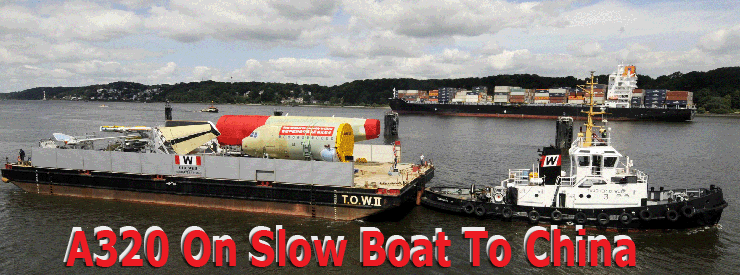
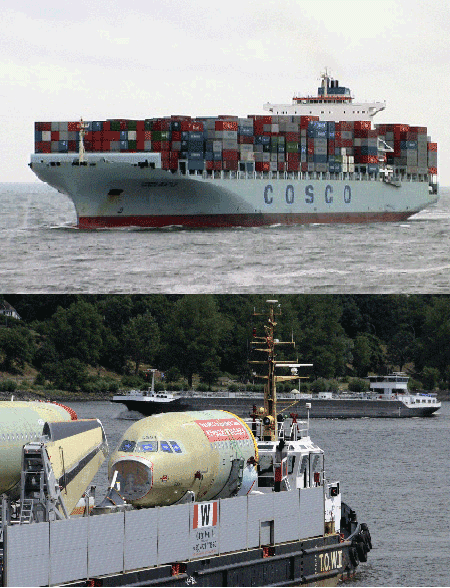
     A tugboat was moving the cockpit, wings, tail and the rear cabin section of a future A320 from Hamburg's Airbus plant to the nearby harbor.
     A decisive step to bring the production of the A320 in China on its way.
     Or better: on the water, because the A320 segments were lifted on board the Cosco Seattle, one of the many huge container ships belonging to China Ocean Shipping Company (Cosco).
     The vessel carried the parts to Tianjin harbor near Beijing where they landed on July 24.
     The aircraft components have now been transported to the nearby brand new Airbus plant.
     Tianjin is the European planemaker's first production plant outside Germany and France.
     In China is where Airbus intends to assemble up to four A320s per month from 2011 on.
     Major clients are different Chinese players like Shenzhen Airlines, Sichuan Airlines or Hainan Airlines that have created big demand for enlarging their fleets with modern equipment who cannot wait.
     The first Tianjin-made Airbus A320 is to be delivered in the first half of 2009.
     According to the global market forecast of Airbus, Chinese carriers need more than 1,900 single aisle passenger jets within the next 20 years.
     In addition there is growing demand for different categories of freighters including smaller versions for courier and postal services.
     It was back in October 2006, when the planemaker decided to form a China-based joint venture for assembling aircraft on the mainland.
     The step was made public during Beijing's announcement to place an order for 150 aircraft of the A320 family.
     Ever since the building of an Airbus factory in Tianjin , awaiting the Cosco Seattle arrival here was favorite sport
     When that kind of excitement rules “Slow Boat To China,” takes on new meaning.
     But all of that is history now and the next headline will be about an Airbus built in China at rollout.
     Stay tuned.
Heiner Siegmund

When Hungry Hippos Hang Out

     “The pillow top mattress is swell but we were hoping for a water bed.”
But rather than say:
     “If you can’t do better, than applaud,” the folks at Lufthansa Cargo’s Frankfurt Animal Lounge just bent over backwards to host two young hippopotami during an overnight stay recently.
     The male and female from the Safari Zoological Center in Tel Aviv were en-route to the Ho Chi Minh City Zoo.
     No weight watchers going on here, either as both of the brownish-red animals, tip the scales together at a respectable 900 kilos and like it.
     Big is beautiful, don’t you know!
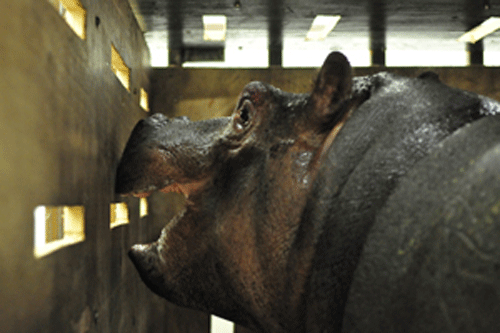
     The hippo duo was transported in extra-large wooden crates with added metal cladding, ensuring a stable and stress-free trip.
     The traveling groom, Mori Hertzenstein, created a water-fest in the Frankfurt Animal Lounge, where they enjoyed a long, languorous shower followed by more than petit déjeuner.
     "Hippos normally spend the bulk of their day in water and their sensitive skin has to be kept moist the way they love it to keep them cool," Mori confided.
     After their brief stopover and pampered treatment, the hippos departed complete with that good home comforts buzz and by all measure more than feeling fine.
Geoffrey